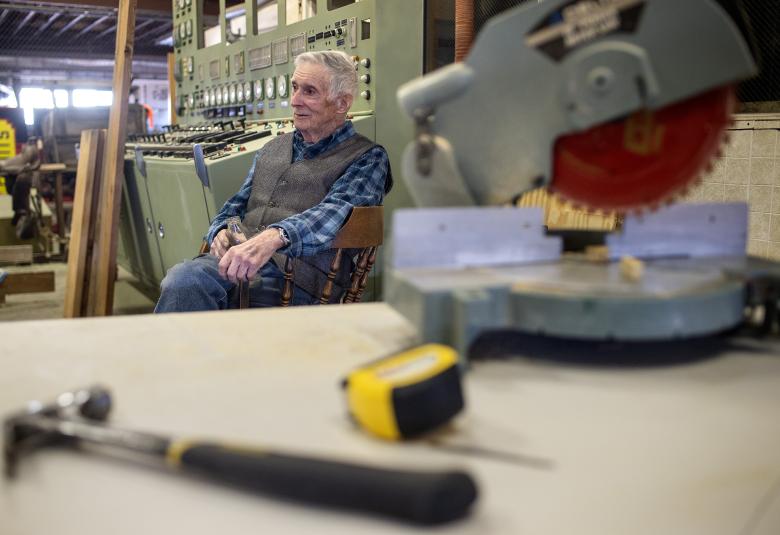
Part-time museum employee uses self-taught skills to restore old relics
GILLETTE — Mike Kennedy spends his mornings in an old maintenance building off of Second Street. The warehouse, which is a storage space for the Campbell County Rockpile Museum, is stuffed with remnants of the past: old sheep wagons, a threshing machine, a loom.
“I love it,” he said. “I just walk around, there’s all this old stuff that I don’t know if anybody other than me is going to see it again.”
Kennedy’s a part-time employee for the museum. He’s been the museum’s handyman, fixing anything that needs fixing. He’s worked on old engines and sheep wagons, restoring these relics to their former glory.
It’s a far cry from his life 50 years ago, when he was an advertising executive in New York City, or from 25 years ago when he was a ski instructor in Jackson.
Kennedy has worn many hats in his 87 years of life, and it’s this constant change that has kept him in good health. The good thing about a mid-life career change, he said, is that “your whole life is in front of you instead of behind you.”
Even with more than 80 years behind him, Kennedy still feels like his whole life lies ahead of him.
As a child, Kennedy lived two lives. He grew up in New York City, but he also spent a lot of his childhood on a farm in eastern Virginia.
“I always say I had a mongrel upbringing,” he said. “I was a little bit of this and a little bit of that.”
This duality continued into adulthood. For 26 years, he worked in an advertising firm in New York City, but on the weekends, he was an amateur tradesman fixing up a dilapidated house in Virginia, including putting on a new roof and rebuilding the chimney.
“At some point, the farm boy in me took over,” he said. “I wanted a rural life, not a city life.”
So at 48, he decided to start over. He left New York City and moved to Wyoming, where he’s lived for the last 40 years, doing a little bit of this and a little bit of that.
Museum Director Robert Henning hired Kennedy as a part-time employee in the summer of 2021. Henning said that at first, he wasn’t sure if Kennedy was the right fit. A lot of museum work involves sitting in front of a computer and processing historic collections.
But he soon realized that Kennedy would in fact fit perfectly with the museum, with his experience in working with tools and engines.
“Someone with his skill set is not easy to find, and when they are (available), I generally can’t afford them,” Henning said.
His first day on the job, Kennedy was walking around the museum property to get a lay of the land. He came across a 10-horsepower Fairbanks-Morse engine that was sitting outside the museum.
It was from the early 1910s, and to his surprise, it was complete. Most engines from that time period were stripped for their parts. It had been outside for several years and was rusting, and Kennedy told Henning he would bring it in and restore it.
“You don’t find somebody that knows how to work with those things very often,” Henning said.
Kennedy’s built exhibit walls, fixed old furniture and restored engines and sheep wagons for the museum. He’s working on restoring an old control panel from the Neil Simpson Power Plant I for a future exhibit.
None of this falls under the job description of a file clerk.
“I’m not sure he’s filed a single thing, actually,” Henning said. “It does not describe what he does for us, not in the least.”
Often, Kennedy will see something the museum has in storage and take it upon himself to restore it. If not for Kennedy, a lot of this work would not be done, Henning said, because “there just isn’t quite enough time to get to these types of projects anymore.”
When he worked to restore a sheep wagon, he got the idea to build his own. Over the course of a year, he put one together, and it will be on display at the museum’s Sheepherder Festival on May 5 and 6.
Kennedy’s completely self-taught when it comes to this type of work.
“I’m a compulsive do-it-yourselfer,” he said. “I’d rather do something myself than hire someone to do it.”
Kennedy was born in New York City in 1936. At the age of 5, his father bought a farm in eastern Virginia and wanted to move the family down there. There was no electricity, plumbing or heating, Kennedy said, “and my mother said, ‘No, we’re not going to live here.’”
“I was brought up as two different people: a little kid on a farm, and a little kid in New York City,” he said.
He went to Cornell and studied classical arts and sciences. He graduated in 1956, then served in the U.S. Army before getting a job at an advertising firm in New York City. He worked his way up from the mailroom to eventually become a senior vice president.
The early years were “wonderful,” he said, because he was still learning. Then he got successful, and it became repetitive. He was working six days a week, and he was hardly at home. He was always in an airplane, flying around the country to meet with clients.
He was making a lot of money, but once he put his three kids through college, he began to question whether he wanted to do this for the rest of his life.
“I said to myself, what’s the point of making all this money? I’m not having any fun,” he said.
While marketing was an exciting industry, it also was highly competitive, “and that creates a little wear and tear on your psyche,” he said.
Kennedy spent the summer of 1953 in Climax, Colorado. He got a summer job at a mining camp, and his life changed. That’s when he discovered the Rocky Mountains and learned about mountain climbing and skiing. From that point on, he felt drawn to the west.
In 1962, he visited Wyoming for the first time. And 21 years later, at the age of 48, he moved to the Cowboy State, where he became a ski instructor and mountain guide in Jackson.
“I had a four word vocabulary: ‘Let’s go, follow me.’ I got paid for that,” he said.
He built his own house in Jackson, and life was good for a while. But in 1996, his wife of 26 years died from cancer. Soon after, he didn’t want to live in Jackson anymore, so he sold his house and moved to Gillette, where one of his children lived.
And that’s when he had another career switch.
He developed an interest in old engines, including hit and miss engines and steam engines. He wanted to get a steam engine, but in order to drive a steam engine around, he needed a truck. So he earned his CDL.
Once Kennedy started driving a truck, he thought he could make money doing it, so he became an over the road trucker. He drove all over the northwest part of the country. After logging a couple million miles, he grew tired of going all over the place, so he wanted to get a truck driving job in the Gillette area.
After several unsuccessful job applications, he was eventually hired by Butch Knutson and Wiz Well Service, and he drove trucks in the oil patch for 10 years. In 2017, the business was shut down, and Kennedy worked for another guy for two or three years before getting laid off.
Kennedy thought he’d had enough of truck driving, but he still wanted something to do. While at the Campbell County Public Library, his friend Dana Urman told him the Rockpile Museum was looking for someone to fill a part-time position.
Henning said Kennedy was confident, outgoing and direct during the interview, and he’s done a lot for the museum in his time here.
“You can challenge him to do something, he’ll figure out a way to get it done,” Henning said.
While Kennedy’s efforts may be unorthodox at times, “in the end, it gets done, and it makes the museum better, and that’s all I can ask for,” Henning said.
And at 87, Kennedy’s not even thinking about retirement.
“I advise people who talk about retirement, I say don’t do it,” he said. “It’s not as much fun as you might think it is.”
He said he’s fortunate to have lived such a long life, and that a large part of that has been due to hard work.
“I really believe the secret to long life is hard work,” he said. “It keeps you in shape and it keeps you motivated.”
For all of Kennedy’s enthusiasm, there just is too much equipment in the museum storage for him to restore all of it.
But he has his whole life in front of him, and he’ll keep on working on a little bit of this, and a little bit of that.
This story was published on April 15, 2023.