Listing of Kohl's $65 million Gros Ventre ranch sparks development worries
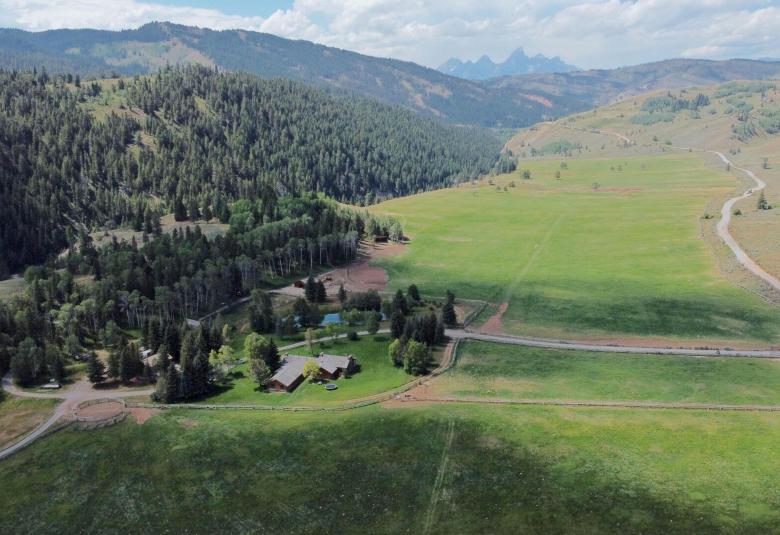
The 190-acre Red Hills Ranch in the Gros Ventre River valley, the longtime summer retreat of the late Wisconsin Sen. Herb Kohl, has been listed for sale for $65 million. Photo by Bradly J. Boner, Jackson Hole News&Guide.
As Realtor tries to sell 190-acre Red Hills Ranch, conservationists worry about development in the Gros Ventre.
JACKSON — Standing on a butte in the Gros Ventre Mountains facing the Tetons to the west, Latham Jenkins looked at the view admiringly.
“Imagine that for your coffee in the morning,” said Jenkins, a Realtor with Live Water Properties who specializes in selling large ranches.
The view Jenkins was talking about was no doubt splendid. Vistas of the Red Hills’ vermillion clays and the migratory path hundreds of pronghorn use to reach Jackson Hole every spring. The meandering Gros Ventre River, backed by the green, irrigated fields of the late Herb Kohl’s Red Hills Ranch and the Tetons’ towering granite.
Jenkins, however, wasn’t talking about the view to make a pitch for the Red Hills Ranch, which he’s been enlisted to sell. Instead, he was highlighting it as an example of Kohl’s moderation. The late Democratic senator from Wisconsin and scion of the family that built Kohl’s department stores owned the ranch for more than 40 years.
But rather than plopping a small mansion on top of the hill to bathe in Teton vistas with his morning joe, Kohl opted to build his private residence downhill and in a stand of aspens, obscuring the building from the road and preserving the view of the Gros Ventre River Basin for other users of the verdant, ecologically rich corridor.
“Herb was reserved and didn’t do that because he knew he didn’t want to stand out. He wanted everyone else to enjoy this gateway into the Gros Ventres and not have his ranch sitting here, shining like a trophy,” Jenkins said. “But who’s to say what the next owner might enjoy?”
That question — what the next owner will do with the property — is front and center as Jenkins works to sell Kohl’s ranch. The question is especially pertinent after a handful of other large ranches in the Gros Ventres sold in the past five years. Some conservationists are wondering what’s next for the basin, which is inhabited year round by mule deer and bighorn sheep and used as a migratory corridor by pronghorn, deer and elk. Humans also prize the relatively undeveloped landscape for its scenic beauty, hunting and hiking.
Though private landowners in the Gros Ventres like Kohl have a long track record of stewarding their properties and being conservation minded, that’s not always guaranteed with new buyers, said Max Ludington, president of the Jackson Hole Land Trust. Private development in the Gros Ventres is always a threat, he said.
“There’s a lot of uncertainty about what would happen with new ownership,” Ludington said. “Nothing’s off the table with development proposals in Teton County. Anyone will try anything here.”
Other Wyoming conservationists and developers say the threat of change in the Gros Ventres is real — but mitigated by physical realities, like the lack of winter access and limited access to electricity.
Still, the Red Hills Ranch, the end of the line for utility-generated electricity in the river drainage, is a place where some development could happen, said Mike Halpin, a Jackson Hole developer whose family owned the nearby Lost Creek Ranch before selling it this year.
“The only place I could see would be Red Hills Ranch cut up into some 35s,” Halpin said, referring to a subdivision of 35-acre lots that Wyoming law exempts from county oversight. “Anything past Red Hills would be pretty impossible due to the lack of power.”
The senator’s vision
Kohl’s property is one of a handful of large ranches in and around the Gros Ventres that have been listed or sold in the past five or so years.
Farther east, the Goosewing Ranch was sold and recombined into a larger, 155-acre parcel in 2021. At the mouth of the drainage, the 118-acre Gros Ventre River Ranch was sold in 2024 and rebranded as the “Grand View Ranch” after being listed for $58 million. Last winter, the Halpin family sold the 46-acre Lost Creek Ranch, which is surrounded by the Bridger-Teton and Grand Teton National Park.
All of that activity is happening in the vicinity of the 640-acre Kelly parcel, a square mile of undeveloped state trust land at the mouth of the Gros Ventre basin. While the state originally proposed auctioning it off for a minimum of $62 million, its appraised value, legislators and federal officials now are seeking a deal that would see the National Park Service buy the land for $100 million, protecting it from development and preserving it for Americans in perpetuity.
Two of the three large, Gros Ventre-adjacent ranches that have changed hands in the past five years — Goosewing and Lost Creek — will continue operating as guest ranches. It’s not yet clear whether the rebranded “Grand View Ranch” will continue taking guests.
With no heirs, Kohl’s estate has listed the 190-acre Red Hills Ranch for $65 million, hoping to maximize the amount of money it can generate for charities the senator founded. But a new owner may not have the same conservation ethic Kohl applied to his property, onlookers warn.
In the mid-2000s, Kohl himself donated 990 acres to the Trust for Public Land, land that was then sold to the U.S. Forest Service for $3 million.
That’s part of why Jenkins, who has listed and sold a handful of other larger properties in eastern Jackson Hole in the past five years, is trying to find a buyer who will appreciate the parcel the same way Kohl did. Without telling prospective buyers what they can do with the property — he can’t, and also can’t look for a specific type of buyer because of fair housing laws — Jenkins is trying to tell the conservation-oriented story of the Red Hills Ranch to attract someone who might share Kohl’s vision for the property, while maximizing money for his estate.
“It’s wanting to find people who are a great cultural fit, with the respect the past owners had,” Jenkins said last week. “That’s getting more challenging as things are changing because Jackson’s become a much more popular place just to own real estate.”
For decades, Kohl operated the Red Hills Ranch as a private guest ranch — but rarely one that he shared with guests.
The Wisconsin senator, businessmen and one-time owner of the NBA’s Milwaukee Bucks would visit three or four times a summer and retreat to his private residence on the hill, Jenkins said. For the remaining weeks, he’d offer up the remaining three guest cabins to friends, staff of his various enterprises and D.C. offices, and others.
They’d stay, enjoy meals cooked and served in the main lodge and take horseback rides on the paint horse herd stewarded by ranch managers Roger and Paula Lasson and, later, Brian and Jodi Cook.
“The presence of the paint horses on the ranch has been a source of pride and enjoyment for me,” Kohl once said of his marbled herd. “The only way I would change it is to have more paint horses.”
New owner, new fears
But other onlookers are worried about change.
After Kohl died in December, the Bridger-Teton quickly began working to acquire a smaller, 152-acre parcel the senator owned farther east in the Gros Ventre River drainage — even though representatives for Kohl’s estate haven’t said publicly what they’d do with the property. The only signal the estate has offered is not including that land with the Red Hills listing.
In general, the Bridger-Teton has sought to acquire inholdings, lingo describing private lands surrounded by public lands like the forest, because they’re difficult to manage. Development on those parcels threatens to cut up habitat the Forest Service works to protect, but inholdings’ presence in the middle of public landscapes also has potential to cause headaches, or upend longstanding ways of managing land.
For example, the Red Hills Ranch is about 4 miles up the road from Slide Lake. Properties farther east mostly are powered by generators. The ranch is only accessible by a stretch of road that’s maintained by the Forest Service and isn’t paved. Potholed and rutted, the road is difficult to drive in the summer but is only accessible in winter by snow machine. It becomes a popular snowmobile trail.
If new property owners farther east asked for easements to build new transmission lines, the Bridger-Teton would have to wrangle with that request. Forest officials also could contend with requests from property owners looking to see the road cleared in the winter. That could upend a longstanding pattern of wintertime recreation in the area, said Todd Stiles, the Bridger-Teton’s Jackson District ranger.
“If all of a sudden, someone would say, ‘Hey, we want to plow all the way in there,’ that’s a problem because we’ve got a snowmobile trail that we’ve had in partnership with Wyoming State Trails for many, many years,” Stiles said. “That could be proposed by someone and, all of a sudden, you’ve got to work through what’s reasonable access.”
In general, the Bridger-Teton establishes relationships with the owners of inholdings, many of whom have permits to run cattle or take guests horse packing on adjacent public lands. But changes of ownership can cause problems as expectations shift, Stiles said.
“If it’s got a long tradition of use as a guest ranch, typically we’ve been working with those landowners for many years. We’ve kind of figured out the relationship,” Stiles said. But if ownership changes “and you have a new expectation from a new landowner, that can really trigger us to have to figure things out.”
Stiles said as much in an earlier interview about Kohl’s 152-acre parcel deeper in the Gros Ventres and inholdings in general. He didn’t respond to a request for comment specifically for this article.
No access, no worries?
Under Wyoming law, the Red Hills Ranch could be subdivided into 35-acre parcels with little oversight from Teton County. Kohl never maxed out his entitlements, Jenkins said.
“You could have more structures, quite a few more,” Jenkins said. “We’ll see who the buyer ultimately will be — a family that will continue loving it as Herb had loved it as a retreat?
“Or could it end up being a developer that wants to maximize what the entitlements here would allow for?” Jenkins asked.
The thought of subdivision worries conservationists.
Aside from migrating through the valley, some elk and mule deer choose to winter on the flat, relatively snow-free terrain that’s also occupied by humans’ pivot sprinklers, irrigated fields and homes. More development in that abundant ecosystem could threaten the landscape and its wild, antlered and horned inhabitants that humans hunt each fall and pursue with cameras year round.
“The thing about the Gros Ventres and with the percentage of public land up there — it’s not mass development you’re talking about. It’s largely inholdings in what is otherwise public land,” said Steve Meadows, a Teton County hotelier who also serves as president of the Wyoming Wildlife and Natural Resources Trust, a state agency launched in 2005 to enhance and conserve wildlife habitat and other natural resource values throughout the state. “But those inholdings are critical winter range, no doubt about it,” Meadows added.
Still, Meadows, Ludington and Halpin estimated that the development threat in the Gros Ventres is not as extreme as elsewhere in Jackson Hole because of its two primary physical limitations: the lack of electricity farther east and the summer-only access road.
Because of those issues, Meadows and Halpin said they anticipate development would happen via subdivision rather than wholesale installation of resort-like amenities like golf courses, even though they’re technically allowed on a property like the Red Hills Ranch under county code. County officials also say permitting a golf course would be a challenge, given the Gros Ventres’ habitat value.
“The only thing you could do is carve it up into 35-acre pieces,” Meadows said. “Then, what are the 35 acres? They’re only going to be accessible to vehicle through June to October. Then you have to snowmobile into them. I’m not sure that pencils for a developer.”
That’s why Jenkins said he’s working to find the right buyer for the land. That’s why he’s drawing on the history of Kohl’s handling of the ranch, his affinity for the painted horses and the natural history of the Gros Ventres as he pitches the ranch to possible buyers nationwide.
In general, he sees a trend that could apply to the Red Hills Ranch — a wealthy buyer purchasing a large property, figuring out where they want to build on it and then putting it under conservation easement.
“That’s generally the play to offset the purchase price,” Jenkins said. “You’re going to define the building envelope, put everything else in conservation. That’s the way I see it.”
Meadows wouldn’t be surprised if that’s where new owners head.
“It doesn’t seem to be a no-brainer like some of the other developments we’ve seen over the years,” he said of further developing or subdividing the Red Hills Ranch. “It seems to me that the Gros Ventre lends itself more to the high-dollar conservation buyers, people who want and have the resources to obtain trophy properties.”
This story was published on August 21, 2024.