Lander-based NOLS brings $19M benefit to Wyoming, but is still in financial hole
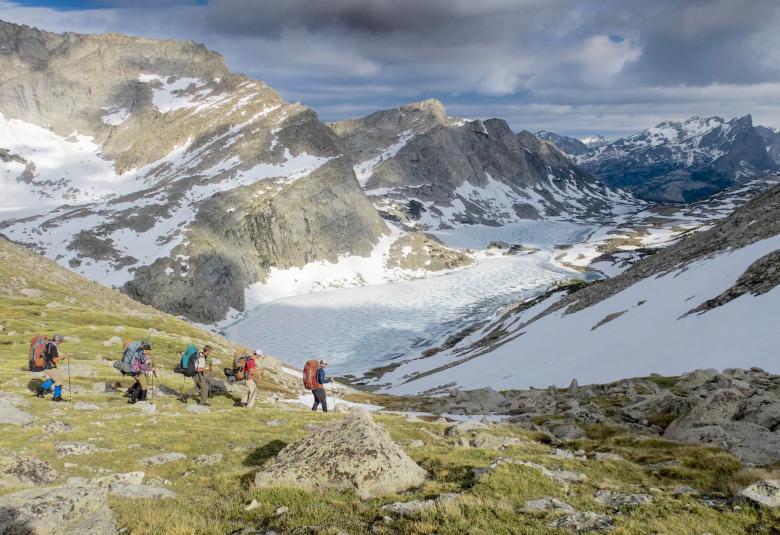
National Outdoor Leadership School students on a Wind River Wilderness course in 2019. (Michael Lans/@mwlans/NOLS)
FROM WYOFILE:
More than a year after shedding jobs and closing campuses, the outdoor leadership and wilderness medicine school shared new economic impact data at 60th anniversary event.
As the Lander-based National Outdoor Leadership School celebrated its 60th anniversary with a cluster of high-profile events last week, President Sandy Calhoun delivered mixed news regarding the state of the organization.
The good: NOLS, which is among Fremont County’s top employers, contributed $18.7 million to the state’s economy in 2024.
The bad: More than a year after shedding dozens of jobs and closing some campuses, the nonprofit school has yet to right its financial ship.
“We have extraordinary momentum at this moment,” Calhoun told a large crowd of NOLS instructors, alumni and friends during a public speech Friday in Lander, before tempering his message. “We’re doing great, but we’re not out of the woods yet.”
Calhoun’s presentation offered insight into the evolution and challenges involved in running what has grown into a multifaceted, $40 million global organization.
With multiple campuses, hundreds of employees and thousands of alumni, NOLS offers expeditions in locales ranging from Alaska to India and Kenya. The school is also a leading provider of wilderness medical training. It offers customized education courses, semesters in the field and instructor certification.
It’s got a lot going on, in other words.
In March 2024, the school restructured, citing an operational shortfall caused by declining student field days and other factors. NOLS eliminated 60 positions and suspended three campuses.
Those changes put the school on a trajectory out of deficit, Calhoun said, but “we’re not there yet.” NOLS experienced a $3.6 million operating loss in 2025, he said.
“So what’s our playbook for the future?” he asked. “We have to focus on financial rigor. We have to continue to reduce costs, year over year.”
Brighter news
One of the more positive moments came when Calhoun unveiled the highlights of an economic impact study conducted by University of Wyoming researchers.
The study found that in fiscal year 2024, NOLS supported 142 jobs and generated $16 million in economic output in Fremont County, where it’s among the top 8% of employers.
“Due to its significant presence, NOLS has a substantial impact on the economy of Wyoming and Fremont County in particular,” the study states, adding that the school also makes meaningful non-economic contributions to the state.
“For example, NOLS Wilderness Medicine provides emergency medicine training to the University of Wyoming Medical school first-year class, the Fremont County Search and Rescue team, Shoshone National Forest rangers, and over 450 EMTs annually qualified to work in the State of Wyoming,” it reads. “Additionally, NOLS contributes to Wyoming’s culture of outdoor recreation, leadership, and stewardship through the courses and experiences it provides to students.”
When you extrapolate that data over decades, Calhoun said, “NOLS has been such a huge contributor to the state of Wyoming, and we’re proud of it, and it’s a story we haven’t told.”
NOLS has certainly helped shape Lander’s culture and economy — attracting many who end up putting down roots in the remote mountain town. But there is also occasional friction between long-time locals and the school, which mainly enrolls out-of-towners for wilderness courses.
In late 2024, Lander’s city council gave NOLS an economic development LIFT Grant of $45,000 for its 60th anniversary festivities. Many residents censured the move as a wasteful use of taxpayer dollars that could be better put toward things like infrastructure needs.
NOLS Board Chair John Babcock, who introduced Calhoun on Friday, addressed the grant controversy.
“We brought hundreds of people to town” for the anniversary events, Babcock said, and “100% of [the grant] investment went directly back into this community … and so it’s been a great reinvestment in Lander.”
Kids these days
Accomplished mountaineer Paul Petzoldt started NOLS out of a cabin in Sinks Canyon near Lander in 1965. The founder had a vision of teaching leadership and outdoor skills on wilderness expeditions.
Six decades later, what began as a humble operation has grown into a seasoned heavyweight in the world of outdoor education. NOLS itself isn’t the only thing that’s different.
“Over the last 60 years, our mission and our values have held steady, but the world around us has changed,” Babcock said. Some of the most drastic differences are in students, he noted. Young people are increasingly brought up to avoid risk. They’re also logging more time online.
When the organization began, he said, “most students arrived at NOLS with experience just exploring their own neighborhoods unsupervised, and today, many students arrive with far less of that. Today, for many of our students, a NOLS course is the first time offline in their life.”
There are also encouraging trends among young people, Calhoun said.
“There’s all this good news that points to the idea that we should have a line out the door,” he said. Nearly 70% of young folks see themselves as outdoorsy, and 80% of Gen Z and millennials want to spend more time outside, according to industry research, he said.
While that creates more demand, companies with outdoor offerings have also proliferated. “The reality, and this is a huge reality for NOLS, is that we are in such a competitive place.”
NOLS’ student satisfaction is consistently high, he added, which reflects very positively on the organization. But the school needs to return key metrics like student time on field courses to growth patterns and find ways to operate in the black.
“We’re not necessarily where we want to be,” Calhoun said. “And there’s work to do.”
WyoFile is an independent nonprofit news organization focused on Wyoming people, places and policy.
This story was posted on Oct. 1, 2025.