


Why Millions Are Walking Away from ‘Organized Religion’
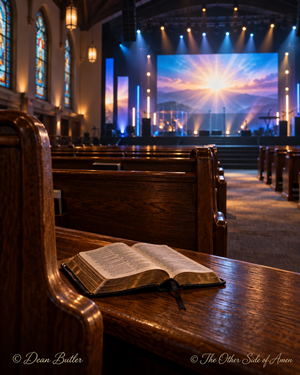
Many people are walking away from organized religion, but not all of them are rejecting Christ. Some are leaving churches that have traded biblical truth for entertainment, programs, personalities, and performance.
Something is happening in churches across America. People who once attended regularly are leaving. Some have walked away from Christianity entirely, but others have not rejected Jesus at all. They are tired of what church has become.
That distinction matters.
It is easy for church leaders to look at declining attendance and conclude that people simply do not want God anymore. In some cases, that may be true. But perhaps we should also be willing to ask a more uncomfortable question: Have some people stopped attending because they can no longer find much of Christ in what we call church?
Many churches have worked very hard to make Christianity attractive. The music is polished. The lighting is professional. The screens are enormous. The coffee is good. The programs are plentiful. The pastor may be entertaining, funny, charismatic, and easy to listen to.
But where is the Word of God?
Paul gave Timothy a remarkably simple instruction:
2 Timothy 4:2 — “Preach the word; be ready in season and out of season; correct, rebuke, and exhort, with great patience and instruction.”
That does not sound much like producing a weekly religious show. Paul told Timothy to preach the Word.
There is nothing wrong with a comfortable building, good music, or using technology wisely. The problem begins when those things become more important than what the church was actually called to do.
Jesus did not tell His disciples to attract crowds by giving people whatever they wanted. He told them to make disciples.
Matthew 28:19–20 — “Go, therefore, and make disciples of all the nations... teaching them to follow all that I commanded you.”
A disciple is not simply someone who attends a service once a week. A disciple learns Christ, follows Christ, obeys Christ, and increasingly becomes like Christ.
That requires more than entertainment.
It requires teaching about sin, repentance, holiness, obedience, forgiveness, sacrifice, prayer, Scripture, and the lordship of Jesus Christ. Those subjects do not always fill auditoriums, but they produce mature believers.
One reason some people are leaving organized religion may be that they have grown tired of being entertained when they came looking for truth.
They are tired of sermons that never challenge them. They are tired of hearing that God wants them successful while suffering believers around the world are told to remain faithful even unto death. They are tired of churches that carefully avoid anything that might make someone uncomfortable.
Paul warned that a time would come when people would not tolerate sound teaching.
2 Timothy 4:3–4 — “For the time will come when they will not tolerate sound doctrine; but wanting to have their ears tickled, they will accumulate for themselves teachers in accordance with their own desires, and they will turn their ears away from the truth and will turn aside to myths.”
We usually read that passage and blame the listeners. And certainly the listeners bear responsibility.
But teachers who are willing to tickle those ears bear responsibility too.
If a congregation wants entertainment and the church supplies it, both sides have a problem.
There is another danger as well. Some churches have become centered around personalities rather than Christ. The pastor becomes the brand. His photograph is everywhere. His books are promoted. His conferences are advertised. People begin talking more about their church and their pastor than about Jesus.
John the Baptist understood something that the modern church desperately needs to remember.
John 3:30 — “He must increase, but I must decrease.”
That should describe every Christian ministry.
The church does not exist to make pastors famous. It does not exist to build religious empires. It does not exist to compete with concerts, theaters, or entertainment venues.
The church exists to glorify God, proclaim Christ, teach Scripture, make disciples, encourage believers, care for one another, and carry the gospel into the world.
And here is where we need to be careful.
Leaving a bad church does not mean we should abandon the church altogether.
The New Testament knows nothing of Christianity lived permanently in isolation. Believers gathered together. They learned together, prayed together, worshiped together, helped one another, corrected one another, and shared life together.
Hebrews 10:24–25 says:
“And let’s consider how to encourage one another in love and good deeds, not abandoning our own meeting together, as is the habit of some people, but encouraging one another.”
So the answer to unhealthy church is not no church.
The answer is biblical church.
Look for a congregation where Scripture is taught honestly. Look for leaders who point people toward Christ rather than themselves. Look for believers who take prayer, holiness, fellowship, and discipleship seriously.
You may not find flashing lights.
You may not find a famous pastor.
You may not find a coffee shop in the lobby.
But you may find something far more valuable: Christians gathered around the Word of God, trying to follow Jesus faithfully.
Perhaps some people who say they are finished with organized religion are really saying something else.
Maybe they are saying, “I am tired of the show.”
If so, I understand.
But do not walk away from Christ because churches have sometimes represented Him poorly.
Do not abandon the body of Christ because some congregations have forgotten their purpose.
Find believers who still open the Bible and ask the question that matters:
What does God say?
The church does not need to become more like the world in order to reach it.
Perhaps the problem is that there is already too much world in the church—and too little church in the world.
_______________________________________________________________________
“What I write is not for everyone, but what I write is meant for someone.” – Dean Butler
This work may be shared for ministry or personal use, but please credit the author when doing so. © Dean Butler | The Other Side of Amen | theothersideofamen.com.
