


Remembering 9/11 — Everything changed
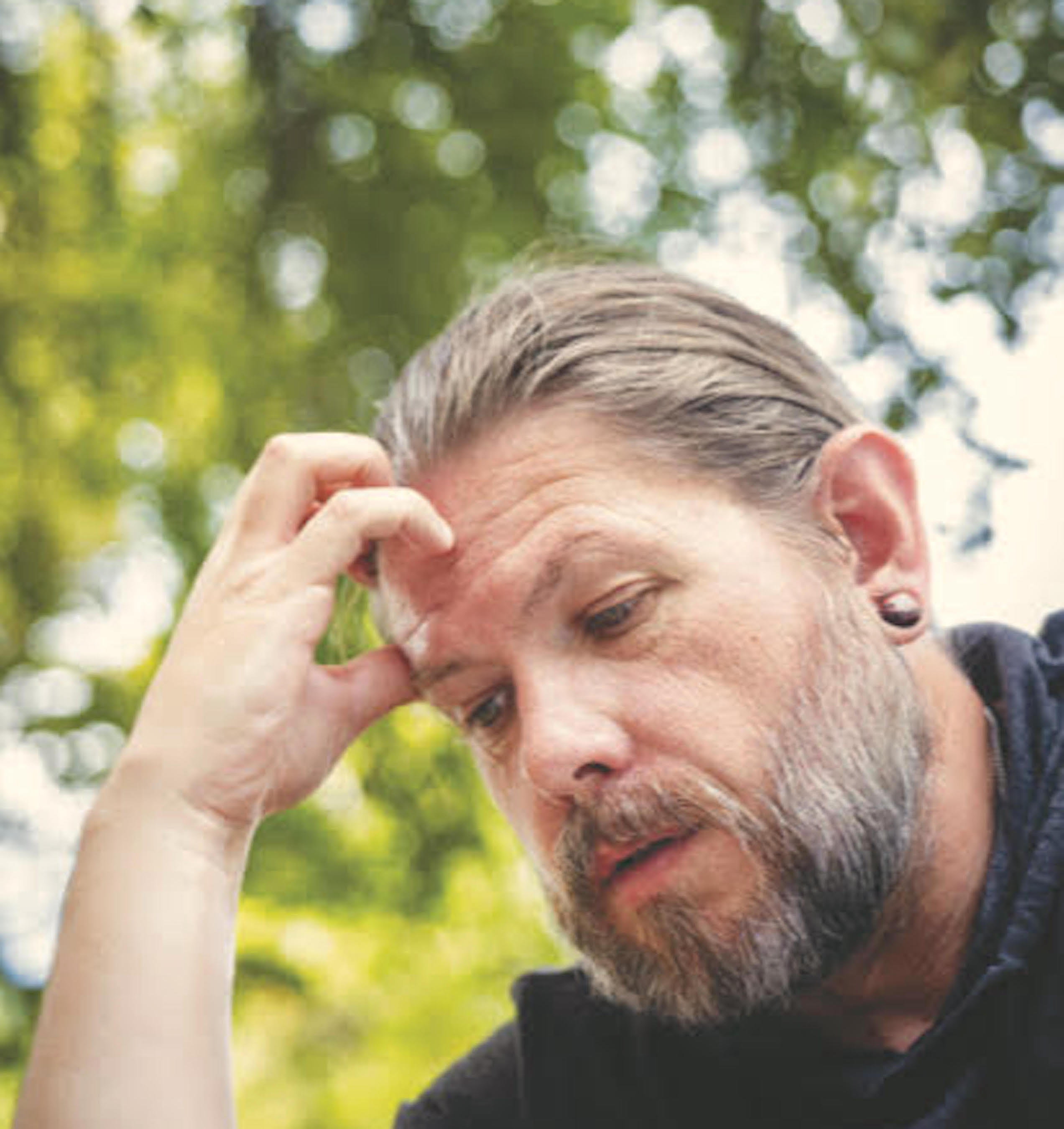
Floyd Whiting enlisted in the Wyoming National Guard just months before the Sept. 11, 2001 attacks. Whiting was eventually deployed to Iraq. Photo by Joseph Ciembroniewicz, Buffalo Bulletin.
BUFFALO — Floyd Whiting, currently a reporter for Sheridan Media, spent years as a member of the Wyoming Army National Guard’s 1041st Engineer Company.
Before any of that, he was a 21-year-old fresh out of basic training, living alone in a three-bedroom basement apartment in Green River.
He joined the National Guard in April 2001, mostly because a friend talked him into it and the Guard offered to pay for college.
He was already married and didn’t want to abandon his wife for full-time active duty, so the National Guard seemed like the practical choice. He hadn’t yet moved her down from their hometown when everything changed.
Whiting had been home from basic training less than a month on the morning of Sept. 11, 2001. He was commuting daily from Green River to Western Wyoming College in Rock Springs, still without internet at his apartment. That morning went like any other; he climbed out of his sleeping bag, showered, got in his Geo Metro and turned on the radio on his drive to campus.
“That’s when I learned everything,” Whiting said.
He pulled his car over and grabbed a tape recorder he carried for his journalism classes. “I fired it up, and I threw it in the corner of that dashboard. And I’ve still got all those tapes,” he said.
What he caught was the initial report of the first tower being hit.
“I thought they’re going to be reporting on this stuff,” he said. “Maybe I can use it in school somehow.”
By the time he reached his mass media class, his instructor was in the hallway crying. They had watched the second tower get hit while Whiting was still driving.
“The class was told to go home – classes are canceled today,” Whiting recalled.
Word spread among the students gathered outside that this wasn’t an accident.
“Somebody who was in the know said, ‘This is a full-scale attack,’” he said. “I was like, ‘How the hell?’” There were no cellphones to call anyone, so Whiting drove to a pay phone about a block from a gas station to reach his wife. By the time he got there, every gas station in town had cars backed up around the block.
“Pickup trucks were full of gas cans,” he said. Word had started spreading that the attack had come from the Middle East. Gas was running around $1.10 at the time.
“We were all worried that it was gonna go up to $2 a gallon,” Whiting said.
Statewide, the Guard’s response moved fast. Every armory was ordered to issue ammunition, and soldiers built sandbagged machine gun positions on armory rooftops in towns that had never needed them.
“All of a sudden, every little small town in Wyoming had a machine gun emplacement on its armory roof, because we didn’t know what was going to happen,” Whiting said.
A Black Hawk helicopter spent its days delivering ammunition statewide. For six or seven months afterward, visiting an armory required identification and a stated purpose.
The culture of the Guard itself shifted.
“Before 9/11, it was pretty much a bunch of buddies getting together to have a good weekend. Have fun. Play soldier,” he said.
That changed very quickly after the attacks.
“The war in Afghanistan and Iraq changed that,” he said. “And for good reason, and for the better. The National Guard is now much more serious and professional than it was.”
He didn’t see any video or photos of the attacks for nearly a week. When his unit finally got a briefing, it came with still images the Army had prepared, deliberately harder to look at than anything on the news.
“Those things stuck with me,” he said.
Whiting said the attacks were followed by a wave of patriotism and support for the country.
“It was what you would want your country to do if we were attacked,” he said. “The sense of patriotism was really, really strong throughout the nation.”
Flags went up outside homes and businesses across the country.
Members of Congress started wearing flag pins on their lapels; a display of unity that hadn’t yet become cliche.
Whiting said the wave of flag flying and lapel pins held on for years, not months, and its retreat happened so slowly that no one could point to the day it ended.
The same period carried an ugly undercurrent alongside unity.
“Racism against Middle Eastern people, and the Muslim people, skyrocketed through the roof,” he said. He didn’t witness it firsthand growing up in Wyoming, a state with few Muslim residents, “but you heard about it,” he said, with reports and stories that traveled even to towns with almost no Muslim population to speak of.
Looking back, he sees the two currents, patriotism and prejudice, as connected rather than separate.
“Patriotism is a wonderful thing,” he said. “But nationalism can wear its mask very quickly. And so you’ve got to be careful with that.”
For Whiting, the lesson of that period isn’t that the flags and the pins were wrong, but that the same instinct that puts a flag on a porch can just as easily curdle into something aimed at a neighbor.
In 2003, Whiting and the rest of the 1041st were activated and sent to Fort Polk, Louisiana, where the unit trained for four months and went nowhere. In 2005, the unit deployed to New Orleans to help clean up after Hurricane Katrina, a humanitarian mission Whiting said he was proud to be part of.
The unit’s deployment to Iraq finally came in 2006. By then, Whiting said, nobody in the unit had doubts left about what they were doing.
“The entire unit was ready,” he said. “There was not one soldier among us who questioned what we were doing, or why we were doing it. We had been preparing for four years at that point.”
In Iraq, Whiting served as a truck commander, responsible for the soldiers riding with him on convoy missions through territory thick with roadside bombs. The unit his crew replaced had been hit by seven IEDs during its rotation. By the end of Whiting’s deployment, his own convoy had been hit by 176 IEDs, a jump he attributed to the U.S. troop surge securing Baghdad, which pushed bomb makers into the rural areas north of the city where his unit operated.
“There’s a constant awareness that you have to have,” Whiting said. “When I’m passing a Pringles can on the road, it’s not a Pringles can.”
Insurgents packed explosives into almost anything, including, in one case, a dead sheep left in the roadway.
As a truck commander, he said the responsibility for the safety of the men around him never let up.
“You’re more worried about their safety than yours,” he said. “That stress never really goes away.”
Some moments were hard to shake. Amid the danger was a level of poverty Whiting said he’d never encountered before: children as young as 3 or 4 digging through burning trash for food, beaten if they came home empty- handed.
“That always stuck with me,” he said.
He described watching convoys pass villages at night with night-vision equipment on, catching glimpses of violence that never fully left him.
“There’s an aura around everything when you’re young, and there’s a way that you think about war that is fed by television and Hollywood,” he said. “And then there’s the reality, which is a very stark contrast to that.”
That contrast reshaped how he sees conflict of any kind, even the small, everyday kind.
“I’ve seen tough guys freeze on a trigger.” Whiting said. “And I’ve seen kids, no older than
19 years old, become heroes in a day.”
Compared with what he witnessed overseas, he said, most displays of toughness back home now strike him as hollow.
Talking with a friend from the unit, someone he’d known since he was 13 and who had ended up serving under him, Whiting found language for how both the Sept. 11 attacks and deployment had changed him.
“Everything just lost its glitter,” Whiting said his friend told him. “In the United States, we live in an illusion of safety. It’s a very strong illusion.”
The return to civilian life was harder than the deployment in some ways. Whiting said he drank for years to cope, avoiding the Department of Veterans Affairs because he knew what he’d be told to do there.
“PTSD is a very real thing, and for years and years of my life, I drank, to self-medicate,” he said.
It eventually took an attempt on his own life for Whiting to get professional help.
He spent two years largely isolated, seeing multiple therapists, before finally going to the VA and doing what he was told to do there.
Asked what he’d tell himself back in 2001, his answer was immediate.
“Get help,” he said. “Don’t be afraid to ask for help.”
Now as a journalist at Sheridan Media, Whiting said he uses his platform deliberately, interviewing veterans, addiction survivors and mental health advocates. He’s blunt about what he thinks Wyoming owes the soldiers it celebrates.
“You celebrate the soldier,” he said. “But we’re the first ones to get screwed when it comes to the pay. If you want to celebrate them, you pay for them, too.”
This story was published on Sept. 10, 2026.
Ensure These Stories Are Told
Despite the challenges facing independent local journalism, what sustains us — and fills us with deep gratitude — is the loyal support of readers who believe our communities deserve accurate, trusted, and locally rooted news.
It is no exaggeration to say that we are here because of you. Every story we report, every local issue we follow, every public meeting we cover, and every community voice we lift up is made possible by readers who understand the value of an independent newspaper.
Your support does more than fund articles. It helps protect the independence that allows us to report honestly, ask important questions, and keep our community informed without fear or favor.
If you are able, please consider supporting the News Letter Journal by donating to our Unabridged Fund today. Whether your gift helps cover reporting time, printing costs, video, photography, editing, or distribution, every contribution helps keep local journalism strong in Wyoming.
All gifts are deeply appreciated. Your support helps ensure that local stories continue to be told, local decisions continue to be watched, and local voices continue to be heard.
Thank you for standing with independent community journalism.