


New generations of Indigenous women find platforms in pageantry
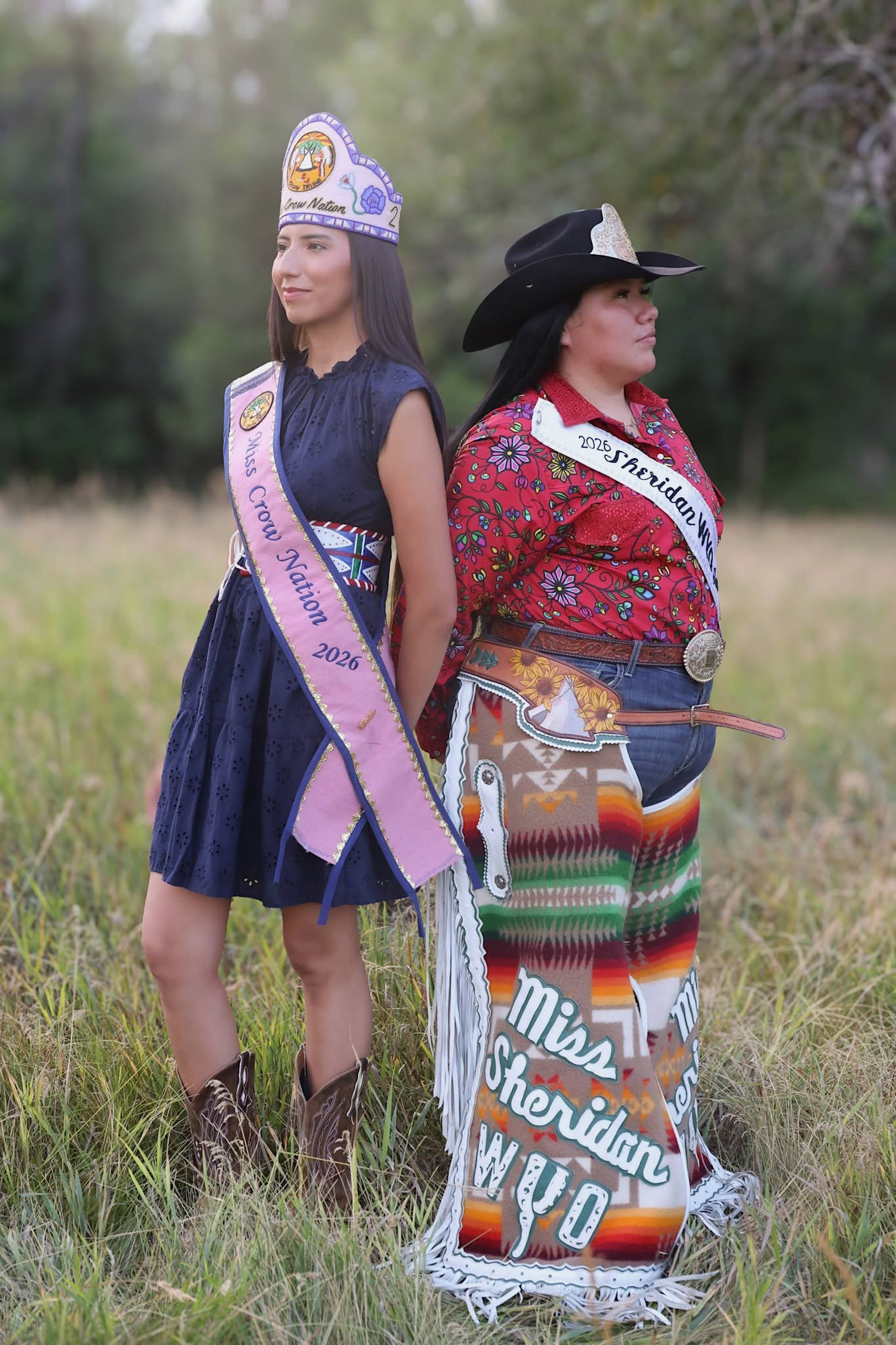
SHERIDAN — Carson Yellowtail sat outside the WYO Performing Arts and Education Center with his Bible open in prayer.
It was June 2025, and his daughter Isabella was competing to be the 2026 Sheridan WYO Rodeo Queen. When she came out to greet her dad, she hid the crown behind her and told him she didn’t win.
Her big smile quickly gave everything away.
“You’re lying, Isabella, and I can see it written all over your face,” he told her.
For Isabella Yellowtail, a member of the Crow nation and a fifth generation rancher, that moment was about more than winning a title. It was a dream and an answer to prayer. Throughout her reign, she used her crown to highlight her love for rodeo and celebrate her Crow heritage. She showcased Indigenous artists and designers, spoke the Crow language and raised awareness about the Missing and Murdered Indigenous Peoples crisis.
But long before Yellowtail wore the rodeo queen crown, other Indigenous women were using their platforms to represent their heritage and advocate for their communities. From 1953 to 1984, a different type of pageant — “Miss Indian America” — crowned 28 Indigenous women from across the nation in Sheridan.
According to artifacts, portraits and data compiled in the Museum at the Bighorn’s newest exhibit, these women created a platform around promoting cultural understanding. In its later years, the program struggled with funding and support. At the same time, a growing number of Native communities wanted to represent their cultures on their own terms and in their own spaces, according to research from the Big Horn City Historical Society. The pageant officially ended in 1989.
Today, new generations of Indigenous women, including Yellowtail and Miss Crow Nation Vanessa Afraidofbear, are participating in the pageant sphere and using their platforms to celebrate their communities and cultural identities on their own terms.
A changing platform
deana harragarra waters (intentionally lowercase per harragarra waters), a member of the Otoe-Missouria nation in Oklahoma, didn’t expect pageantry to become a big part of her life. But when she won Miss Indian America in 1975, she came to see the crown as something more than a title.
“It was about your interest in making the world that you lived in much better for you and for those around you,” harragarra waters said.
During her reign, she spent a year in Sheridan, where she became a part of the community and traveled the country to speak at events. She never saw Miss Indian America as a beauty pageant. Instead, it was an opportunity to learn about the history and culture of her nation and share that knowledge with others.
“Miss Indian America had the platform embedded into the title, and that was to work on human relations, so that was, to me, the biggest difference (from other pageants),” harragarra waters said.
But harragarra waters saw this mission begin to change in the pageant’s later years. After 31 years in Sheridan, the program moved to Bismark, North Dakota. It ended five years later, due to waning interest and a lack of funding.
Should a program of a similar nature come back? Harragarra waters isn’t so sure.
“I personally don’t know how it can be replicated, or the message (and) purpose of it might better be accomplished in different ways, in different manners,” harragarra waters said.
But harragarra waters has already seen Indigenous women find new ways to carry that purpose forward, including Yellowtail with her Sheridan WYO Rodeo Queen crown.
“That role of Miss Indian America was more of a spokesman for what's happening with Indians in America. That was the role, and that's the same role that I see Isabella, whether she was a rodeo queen or Miss Indian America,” harragarra waters said in a 2025 interview with The Sheridan Press.
The next generation
Yellowtail and her family are members of the Crow Nation, and she began participating in pageants at the annual Crow Fair celebration. In 2023, Yellowtail became senior princess of the Sheridan WYO Rodeo. Last year, she was the second Crow woman ever to hold the Sheridan WYO Rodeo Queen title. The first was Lucy Yellowmule 75 years ago — who also happens to be Yellowtail’s relative.
As Sheridan WYO Rodeo queen, Yellowtail’s title centered on rodeo and her passion for it. But Yellowtail also chose to incorporate her Crow heritage into her platform.
Throughout her reign, her wardrobe consistently featured Indigenous artists and designers, including outfits styled by Della BigHair-Stump, jewelry from Jacinta Jefferson, beaded earrings from Tanessa Takes Enemy and other pieces from Bethany Yellowtail. Her chaps, made from a Pendleton blanket by Christa Hodson Branch, are decorated with sunflowers, a Crow-style tipi, Bible verses, a “Circle Lazy H” brand and the initials of her papa, Blaine James Small.
Yellowtail also used her platform to spread awareness for the Missing and Murdered Indigenous Peoples crisis and spoke the Crow language on many occasions, including her farewell speech in July.
Vanessa Afraidofbear, 2026 Miss Crow Nation, said speaking the Crow language is an important part of her title. The Montana State University student has given speeches in Crow at powwows and at Crow Fair, an annual celebration in Crow Agency, Montana that wrapped up last weekend.
“A lot of the talk is about losing culture (and) start(ing) to lose language,” Afraidofbear said. “Seeing all these girls put themselves out there, do the pageant, take time to learn their language and be able to give a speech is probably one of the best things.”
Afraidofbear grew up attending powwows with her family and always dreamed of becoming Miss Crow Nation. But outside of Indigenous communities, Afraidofbear never saw a lot of Native representation in state and national pageants, like Miss Wyoming, Montana or Miss America.
Afraidofbear said this is changing.
Rachel Evangelisto, a member of the Húnkpapha Standing Rock Sioux Tribe, won the Miss Minnesota title in 2022. In 2024, Ashley Callingbull became the first Indigenous woman to win Miss Universe Canada. But at Miss America, no woman of Indigenous heritage has won the crown since Norma Smallwood in 1926.
For women like Yellowtail and Afraidofbear, representation is happening locally, not just nationally.
Yellowtail said she’s felt welcome in pageant spaces, and has received so much love and support for showcasing her Crow heritage. But she knows stepping into those spaces takes confidence. She hopes her leadership can encourage the younger generation as well.
“I want them to know that they belong in those spaces that seem big, broad, out there and out of reach,” Yellowtail said. “I want them to not be afraid of showing who they are.”
Yellowtail also hopes people don’t have to wait another 75 years for a member of the Crow Nation to sit under the Sheridan WYO Rodeo crown.
“Any crown, as a matter of fact,” Yellowtail said. “It can be Miss NPRA, Miss Rodeo Montana, Miss Rodeo Wyoming. It can be anything.”
This story was published on August 20, 2026.
Ensure These Stories Are Told
Despite the challenges facing independent local journalism, what sustains us — and fills us with deep gratitude — is the loyal support of readers who believe our communities deserve accurate, trusted, and locally rooted news.
It is no exaggeration to say that we are here because of you. Every story we report, every local issue we follow, every public meeting we cover, and every community voice we lift up is made possible by readers who understand the value of an independent newspaper.
Your support does more than fund articles. It helps protect the independence that allows us to report honestly, ask important questions, and keep our community informed without fear or favor.
If you are able, please consider supporting the News Letter Journal by donating to our Unabridged Fund today. Whether your gift helps cover reporting time, printing costs, video, photography, editing, or distribution, every contribution helps keep local journalism strong in Wyoming.
All gifts are deeply appreciated. Your support helps ensure that local stories continue to be told, local decisions continue to be watched, and local voices continue to be heard.
Thank you for standing with independent community journalism.