


‘I can recall everything’
A community, state grapples with grief 25 years after crash killed 8 UW runners
CHEYENNE — The last time Tyson Shatto saw his cousin alive, he sat silently and mourned for thousands of strangers.
He grieved for his cousin, Shane Shatto, two days later.
A split-second maneuver destroyed eight lives, rattled a state, university and community, and boomed into a national news story within hours.
Eight University of Wyoming men’s cross-country runners died upon impact at about 1:30 a.m. Sept. 16, 2001, 17 miles south of Laramie, when Clint Haskins — an intoxicated UW rodeo athlete headed south — swerved across the two-lane U.S. Highway 287 blacktop and rammed his one-ton Chevrolet pickup truck into a northbound Jeep Wagoneer, which carried the runners.
It was the deadliest vehicle accident in state history.
Cody Brown, 21, of Hudson, Colorado; Kyle Johnson, 20, of Riverton; Joshua Jones, 22, of Salem, Oregon; Justin Lambert- Belanger, 20, of Timmins, Ontario, Canada; Morgan McLeland, 21, of Gillette; Kevin Salverson, 19, of Cheyenne; Nicholas Schabron, 20, of Laramie; and Shane Shatto, 19, of Douglas, never made it home from a Saturday excursion in Fort Collins, Colorado.
Only Haskins, who operated behind the wheel with a 0.16% blood-alcohol level, survived. He was sentenced to 14 to 20 years in prison for eight counts of aggravated vehicular homicide, but was paroled 10 years later.
Today marks the crash’s 25th anniversary — a time that triggered dozens of annual tributes, multiple memorials, legislation changes and highway safety improvements.
The grief never left those associated with the event, and it never will.
Time can’t diminish the pain. Decades don’t soften the emotions for then-UW cross-country head coach Jim Sanchez. They don’t erase years worth of relationships.
Twenty-four years or 26, he said, it doesn’t matter.
“This year is not any more special than next year or the following year, because we are always remembering them,” Sanchez said. “We still carry the torch. We quietly beat the drum.
“In the background, I am always hearing the drum beating, and we are always thinking about them. The drums do get a little bit louder on the 16th (of September).”
Tyson Shatto, meanwhile, was one “yes” away from joining the eight on their trip.
As a nation reeled from the aftermath of the 9/11 terrorist attacks, flights stalled, cancellations occurred across college athletics and the impacts hit Laramie too.
“(The events) were all crunched together,” then-UW President Philip Dubois said. “We were reeling from 9/11, and then we had this horrific scene on campus and throughout the state.”
With grounded flights and airlines jammed, Dubois’ wife was stuck in Italy on a trip.
The university canceled or postponed athletic events, which suddenly allowed an open date for UW’s cross-country teams. The Cowgirls were scheduled to compete Sept. 15, 2001, at the University of Denver Invitational, but withdrew because of the events of 9/11, according to ESPN. The Cowboys were not.
Tyson Shatto, a member of UW’s wrestling team, was supposed to compete that weekend, too.
The eight runners, with a free weekend, visited Fort Collins for a day of shoe shopping and dancing.
The crew, according to the Casper Star-Tribune, started the journey in Cheyenne, where Salverson’s high school cross-country coach owned a Foot of the Rockies shoe shop. They didn’t like the options, so they traveled to Fort Collins.
The Shatto cousins attended the university’s 9/11 candlelight vigil Friday, Sept. 14, 2001.
“At that candlelight vigil, Shane invited me to go with them down there,” Tyson Shatto said. “When I think about that, it makes the hair on my neck stand up because I was invited to what would ultimately be where they were killed by a drunk driver.”
Tyson Shatto instead returned home to Douglas to celebrate his Sept. 15 birthday. Though a year apart in school — Tyson Shatto was then a freshman and Shane Shatto a sophomore — the two lived like brothers. They walked identical routes to and from classes, ran into each other in the weight room, and Tyson Shatto always chucked rocks at his cousin’s window in the Sigma Phi Epsilon fraternity house.
A mortician alerted the family a day later.
“(The mortician) didn’t say much,” Tyson Shatto. “He just said to my dad that we need to get to my uncle’s house, and it was tragic, and we needed to get there soon. We knew something was wrong. We didn’t know exactly what.”
Relatives consider the hypotheticals. It still tugs at them — knowing the potential and how college only started the eight’s path toward a life after athletics.
“For 19 years, Shane was a living, breathing part of our family,” Tyson Shatto said. “For 25 years, we have had to know him from memories.”
The eight dreamed of careers as doctors, engineers and teachers — fields that surviving teammates now thrive in.
Tyson Shatto often drifts into that mindset — what would a 44-year-old Shane Shatto do? Where would he live?
“When I think of Shane then, I think of just the adventurous, happy-go-lucky fun kid that he was,” Tyson Shatto said. “I just see him raising a family in that same manner. Getting out, being active, making sure that they were part of society and doing things that were fun for them and pushing them to be good people.”
Shane Shatto, at the time of his death, studied engineering in pursuit of becoming an aeronautical engineer. He planned to enroll at the U.S. Naval Academy, but color blindness prohibited that.
Shane Shatto’s father, Kerry, marks the anniversary when he releases eight balloons at his son’s grave.
He attaches a note that reads, ‘“We miss you,’” according to the Associated Press.
“(Shane) was a leader,” Tyson Shatto said. “I think about all the lives he would have touched as he got older. You just start thinking about those things now where we are at the age that we are and the memories that we have of Shane when he was so young.”
Tyson Shatto now teaches and coaches wrestling at Sheridan High, which equips him with the perspective of working daily with students close to, if not exactly, the same age as Shane Shatto when he died.
“That changes the way you look at 19-year-olds,” he said. “You realize how young they really are and how much life they are supposed to have ahead of them. I feel an obligation to remember that life is precious.
“The decisions you make have consequences. A five-minute bad decision can have a generational impact. I think about that a lot.”
He slips stories of his cousin into his teachings and won’t pass any opportunity to bring those memories closer to others.
“I don’t think you can stress it enough just how fragile life is, how important life is and how important faith is,” he said. “I just think it is important that people love one another and not be resentful and hateful.”
It doesn’t stop there. Tyson’s daughter, Maci, just started driving.
“It is events like this where you know when you are young and things like that, you think like, ‘This kind of thing can’t happen to me,’” Tyson Shatto said.
“We are living proof that they can. You just have to let them venture out and do things, but at the same time, it is always kind of in the back of your mind, too. You kind of think about those things as a father.”
‘I can recall everything’
Lee Moon awoke with a jump.
Nothing unusual about after-hours phone calls for Moon, then-UW athletic director. But colleagues won’t call close to 2 a.m. on a Sunday.
It plunged Moon deep into the center of one of the state’s deadliest events.
He snatched up the phone to hear a state trooper on the other end. An accident. He demanded details — what were the severity of the injuries? Any survivors? The state trooper wouldn’t budge.
News occurred in waves for Moon after the troopers notified next of kin.
Call by call, he learned of the deceased.
Seventeen days prior, he watched the eight compete in the Wyoming Open cross-country meet.
The memory has never been wiped from his mind. It’s the stuff that sticks with you decades later — an emotional scar magnified by sentimentality.
“I can still, in my mind, see them running,” he said.
Folks had a nickname for Johnson. Ichabod — Moon said — because of his thin, tall frame, reminiscent of Ichabod Crane.
“I can see him running,” Moon said. “He was really long and thin and gangly. I can still see him running.”
Details like that carried throughout his 37-year career as a Division I athletics director. They never disappeared.
Not the call, the sight of the crumpled-up Wagoneer, the full slate of funerals in one week or the 3,000 to 4,000 people who piled into the Arena- Auditorium for the Sept. 25, 2001, memorial service.
“I can remember going down to the compound where they towed the vehicle — what was left of it to show me,” Moon said. “They wouldn’t show me the pictures of what all happened. All (the police sergeant) did was tell me that the crash site looked like a battlefield in a war because the bodies were everywhere.”
Only a flat frame with four wheels remained.
He never sought counseling to address the grief. It remains “my big regret,” he said.
“I should’ve done some grieving and had some counseling to get me through it because I still, when it comes around to this time of the year (and) the anniversary shows up, I can recall everything,” Moon said.
The season trudged on. Moon rented a 55-passenger charter bus, which athletes, coaches and administrators packed — en route to funerals.
They attended 10 — because divorced parents among some of the eight requested separate services — within a week.
Back in Laramie, only a venue such as the Arena-Auditorium could accommodate the thousands who attended the memorial service.
Coaching staff and cross-country athletes from each Mountain West team also attended, Moon said.
“We had easels with their very large mugshots on the stage,” then-UW sports information director Kevin McKinney said. “I am going, ‘How on earth could eight young guys be snuffed out like that in one event?’ and the grief that (their families have). When you have kids, it is really hard to fathom losing one of them.”
UW hosted a similar memorial service in 2024 for UW swimmers Carson Muir, Charlie Clark and Luke Slabber, who were killed in a single-vehicle crash on Highway 287 on Feb. 22, 2024.
“Huge crowd,” McKinney said. “Extremely emotional. It was like (the 2024 memorial service) in terms of having student-athletes and teammates speak. They do the best. They are not only emotional, but they are close to them. So it was a tearjerker.”
Guiding a school and community through tragedy was nothing new for Dubois.
In 1998, UW student Matthew Shepard was murdered outside of Laramie in a case that became a watershed moment for gay rights and LGBTQ advocacy.
By the time of the 2001 crash, Dubois was “well-practiced” in navigating tragedy.
“Basically, you become the mourner-in-chief,” he said.
In 2019, when Dubois served as chancellor at University of North Carolina at Charlotte, former student Trystan Andrew Terrell walked onto campus with a nine-millimeter Glock 17 pistol in hand and killed two and injured four.
It was April 30, 2019 — the semester’s last day of classes.
‘All of them’
Twenty-five years ago, on Sept. 16, McKinney wheeled out of a hotel parking lot in La Junta, Colorado — the town where his son attended Otero Junior College — and pointed his vehicle north toward Laramie.
McKinney didn’t get far before Moon called.
“I said, ‘How many killed?’” McKinney recalled. “‘(Moon) said, ‘All of them.’ I will never forget him saying that. All of them. I said, ‘Eight kids?’” McKinney needed to act quickly, and he knew who to call. He connected with Oklahoma State sports information director Steve Buzzard, who handled the fallout after a January 2001 plane crash in Colorado, which killed all 10 people on board. The travel party featured two crew members and eight members associated with the men’s basketball programs.
Sensing success
Runners often scattered and diverted their separate ways after practice. This was no ordinary session.
Sanchez, in 2001, was in his 20th year as UW’s cross-country coach, when he sensed a different vibe. He detected a subtle aura after the team’s long run in the Snowy Range Mountains. A quiet confidence fond to coaches projected what this team could have been.
The pieces assembled among a young squad that needed to replace plenty of experience.
“You could sense that they knew they had a team,” he said. “They sensed that they had a team and they were going to be pretty good that year.”
A week later, the Cowboys finished sixth at the Colorado State Open.
“I think that is when they really started finding themselves as a team,” Sanchez said. “They were starting to realize that each one of them had a special part in putting that team together. It didn’t matter if they were No. 1 or No. 5.”
He leaned on Lambert- Bélanger, a quiet, blondehaired Canadian who ditched his northeastern Ontario mining town for the high plains after a season at Campbell University.
Lambert-Belanger boasted UW’s top times in the team’s two meets prior to the crash, according to ESPN.
He relished nature and its solitude. Laramie became a natural fit. His father, Richard, shipped him a camping tent, according to a 2011 Laramie Boomerang article.
It arrived a day after his death.
Douglas’ Shane Shatto emerged as Sanchez’s “ace in the hole.” A state champion wrestler for the Bearcats, he blossomed on the trail and won the 1999 Class 3A cross-country state championship.
Reminiscing pushed families and others through the darkness. It wasn’t shoved aside and ignored for decades.
“We didn’t suppress it and not talk about it and try to put it away,” Tyson Shatto said. “We tried to celebrate Shane’s life as much as we can and share stories and just talk about him. Just so that it is not like something that just happened and then you move on. It is something that you carry with you, and it is something that you shared together.
“It is something that you can help each other through in remembrance of Shane and who he was, how he made you feel and fun stories that maybe they hadn’t heard.”
Tragedy didn’t destroy the season. Bonded through grief, the team met at 3:30 p.m. daily in the UW Fieldhouse for the two weeks following the event.
“We would talk,” Sanchez said. “We would cry. We would hug. We were just checking on each other every day.”
When the two weeks passed, team captain Chris Jons approached his coach.
“(Jons) stated that it was time,” Sanchez said. “It was time to get back on the horse. We needed to go forward. It wasn’t going to be easy. But after the beating that we had just taken, we were not afraid of failure.
“We were going to compete. We were going to go back and compete. That is all we could do. The men’s and women’s teams got back on the course, and in the process, they honored their fallen teammates. They also honored themselves.”
With what Sanchez called a “patched-up” team — three returners, two redshirt freshmen and two middle-distance athletes brought over from the track team — returned to the course Oct. 8, 2001, at the Rocky Mountain Shootout in Boulder, Colorado.
They finished the season in November at the Mountain Region Championships.
“I think there is a time that you grieve and it is terrible, and then you say, ‘OK, let’s go,’” McKinney said. “Got to keep going. Because if you don’t keep going, you just dwell on it, and that is no good, mentally, at all.”
What changed?
McKinney abstained from driving the route for 15 years after the event.
He couldn’t bring himself to do it. A 25-mile detour — east to Cheyenne on Interstate 80, then southbound on Interstate 25 — to get to Fort Collins was worth it to avoid flashbacks.
“Day or night,” he said. “Clear weather or not. Shortcut or not, I just didn’t do it. It took me a long time to get to the point where I would take the road.”
It wasn’t the first event that infamously ties UW with the north-south route.
The crash headlines an all-too-familiar history of deaths on Highway 287, particularly with those linked to the institution.
Ruben Narcisse never fulfilled his medical field aspiration. A heralded linebacker from Miami, Narcisse died a week into his freshman season as a Cowboy.
He died on Sept. 6, 2010, six miles south of the Wyoming state line, when teammate Trey Fox, driving a Toyota Tundra, fell asleep at the wheel.
Narcisse was ejected from the vehicle. The three others in the truck survived.
“Obviously, you don’t want to forget,” UW athletics director Tom Burman said. “You want people to think about and remember them. ... We have lost athletes. We have lost athletes in swimming. We have lost athletes in football. Track and field.
“Every athlete’s death is just tragic, but because it was eight, and because it was so senseless, that one stands above the rest. Still, I think of them all.”
Multiple efforts to increase highway safety occurred throughout the decades, which derived from the 2001 incident.
Petitions, such as one from Laramie resident Michael Garey in 2024, proposed increased law enforcement presence on Highway 287 after an oncoming car, which attempted to pass another vehicle, ran Garey off the road.
In 2009, the state started work on a $9.1 million project, which widened the highway from two to four lanes, including a stretch south of Tie Siding, where the crash occurred, to the Colorado border.
The first 10 miles of that project was complete, according to Wyoming Public Radio, but 11 miles remained. Because of funding limitations within the State Transportation Improvement Program, the Wyoming Department of Transportation “moved to a pavement preservation mode.”
“What are you worried about on 287?” McKinney said. “Head-ons. That is what happened. It happens all the time.”
That 30-mile span of 287 from the Wyoming line to north of Fort Collins featured 570 crashes, including 15 fatal cases, within the previous five years when the Colorado Department of Transportation released a report in 2023.
The state of Wyoming, in 2002, shrunk the legal limit for a driver’s blood-alcohol content from 0.10% to the federal standard 0.08%. It also banned open containers of alcohol in vehicles in 2007. Blood tests are also required to determine a driver’s blood-alcohol concentration in all fatal crashes.
Multiple family members of the victims live a life dedicated to safety advocacy and teaching the dangers of impaired driving.
McLeland’s mother, Debbie, pulled Haskins out of prison and routinely traveled the state, speaking to high schools and communities about impaired driving.
“Some people are really angry that I’m even talking to him, but I think it’s important,” Debbie McLeland told the Laramie Boomerang in 2011. “It doesn’t accomplish anything to sit there and be angry and fester.
“You might as well, as far as I can see, get out there, deal with it and do good things if you can, because there’s no way to hide from this. It’s not a private thing. It wasn’t a private thing when it happened.”
Debbie McLeland died Sept. 30, 2024. She was 73.
“I can’t imagine (Haskins),” McKinney said. “I guarantee you he wondered why he wasn’t taken. But he survived it. But to do that took a lot of courage on his part, too. Not only (Debbie McLeland’s), but his, to go out and face up to that.
“Looking at faces that were the age of the kids you took. That is remarkable to do that.”
Constant education
The story was foreign to Aidan Ramsey.
Hailing from central Iowa and spending most of his life in the same two counties, he sought alternative options after three seasons at Drake.
The importance of the eight rocked Ramsey within hours of arriving in Laramie for his official visit.
UW cross-country coach Scott Dahlberg emphasizes the event — and the importance of remembrance — during every recruiting visit.
Ramsey couldn’t ignore that.
“It is a great reminder to not take things for granted,” he said. “Obviously, the training and the school, everything piles up, and it can kind of be brutal sometimes, but just remembering that we get to do this.
“It is a great opportunity to do what we love with our teammates. Not everybody has that opportunity.”
Athletes from far-flung regions quickly acclimate to the event’s importance.
Dahlberg encourages team participation in the 10-mile Silent Trails Memorial Race at Tie City Trailhead, which started in 2002 in remembrance of the eight.
Dahlberg was a 17-year-old Colorado high school student when the crash occurred. It dominated the news cycle.
“It is definitely something that is worth our time and effort to make sure that we do the best we can to carry on the things that have happened before us,” he said.
Chris Schabron, the brother of Nick Schabron, organizes the Silent Trails Memorial Race. It’s a quick way for Dahlberg to drill the event into his athletes’ minds.
“We became pretty aware of it pretty fast,” UW junior Hanan Aldelemy said.
It’s the same situation in Gillette, where participation in the 16th annual eight-mile Memory of the 8 becomes a practice for Campbell County and Thunder Basin high schools.
Gillette’s Sonny Roberts, between 12-hour shifts in the coal mine, labored toward his goal of competing in the 2002 Boston Marathon. He didn’t know any of the eight. He didn’t need to. He respected any fellow runner, and their memory motivated Roberts to later organize the race.
“I needed a motivator,” Roberts said. “I chose to run a mile for each, and that is what got me through my training.”
Dahlberg and assistant coach Oisin O’Gailin will participate in the race. The run starts at M&K Oil Company headquarters, where McLeland’s brother, Nathan, serves as chief executive officer.
“It was all about running,” Roberts said. “It was never meant to be anything, really. It turned out to be a great event.”
Memorial events — in cross-country or other sports — sprinkle teams’ schedules.
Riverton hosted the Berry Bryant/Kyle Johnson Memorial XC Meet on Sept. 5. Cheyenne Central hosts the Kevin Salverson Invitational indoor track and field meet every January. The Justin Lambert- Bélanger Relays occur every June at the Timmins Regional Athletics & Soccer Complex in Ontario, Canada.
Gillette’s Sage Valley Junior High hosts the Morgan McLeland Invite every cross-country season.
Tyson Shatto’s Sheridan wrestling squad annually competes in Douglas’ Shane Shatto Invite. The Broncs won the 2023 event.
“Every year I go, there is a little different remembrance of Shane or a little different way that we approach it,” Tyson Shatto said. “It is a special event. It is awesome that it memorializes Shane and gives people a message of why we don’t drink and drive and the impact that it has on people.
“I don’t think there could be enough events that kind of trademark things like that that should give people things to think about. If we can get shirts back in Sheridan that say, ‘Shane,’ on it and I can see that, that just makes me smile. I don’t want to go through life not thinking about Shane or (not) seeing signs of him. That makes me smile.”
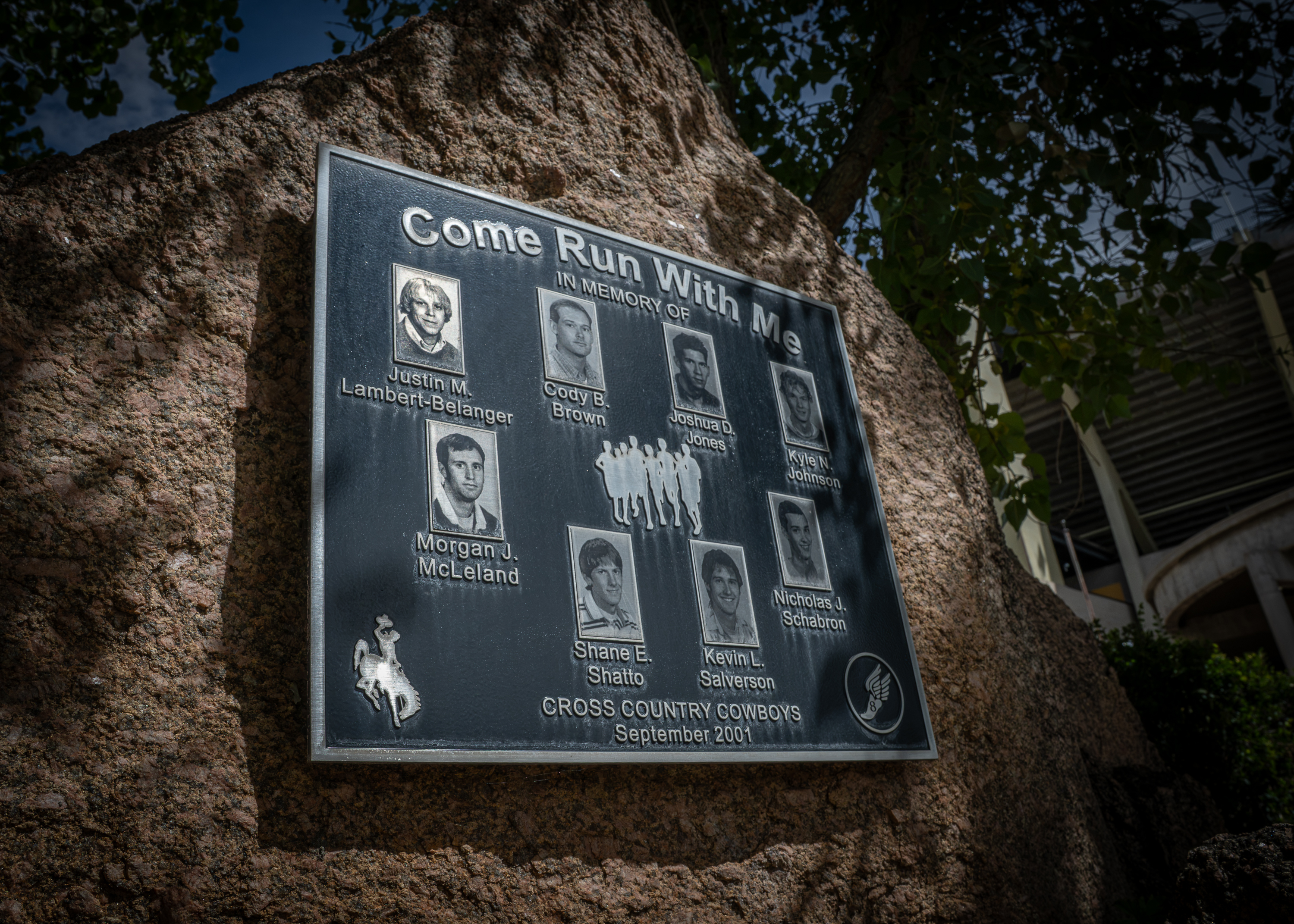
The UW cross-country teams often run past the Remember the 8 memorial garden — positioned on the south side of the War Memorial Fieldhouse — during practices.
Head shots of the eight, with their names inscribed below each photo, are included on a black plaque that reads “Come Run With Me.” It is pinned to a large boulder that stands out among rocks from Vedauwoo, where the team often trained.
In 2006, UW renamed its outdoor track at the Louis S. Madrid Sports Complex the “Memorial 8 Track.”
“I just think about them,” Sanchez said. “I don’t try to replay the accident. I just think about them on that day.”
This story was published on Sept. 16, 2026.
Ensure These Stories Are Told
Despite the challenges facing independent local journalism, what sustains us — and fills us with deep gratitude — is the loyal support of readers who believe our communities deserve accurate, trusted, and locally rooted news.
It is no exaggeration to say that we are here because of you. Every story we report, every local issue we follow, every public meeting we cover, and every community voice we lift up is made possible by readers who understand the value of an independent newspaper.
Your support does more than fund articles. It helps protect the independence that allows us to report honestly, ask important questions, and keep our community informed without fear or favor.
If you are able, please consider supporting the News Letter Journal by donating to our Unabridged Fund today. Whether your gift helps cover reporting time, printing costs, video, photography, editing, or distribution, every contribution helps keep local journalism strong in Wyoming.
All gifts are deeply appreciated. Your support helps ensure that local stories continue to be told, local decisions continue to be watched, and local voices continue to be heard.
Thank you for standing with independent community journalism.