


Gillette College asks legislators to change law that requires college districts to tax 4 mills to get state funding
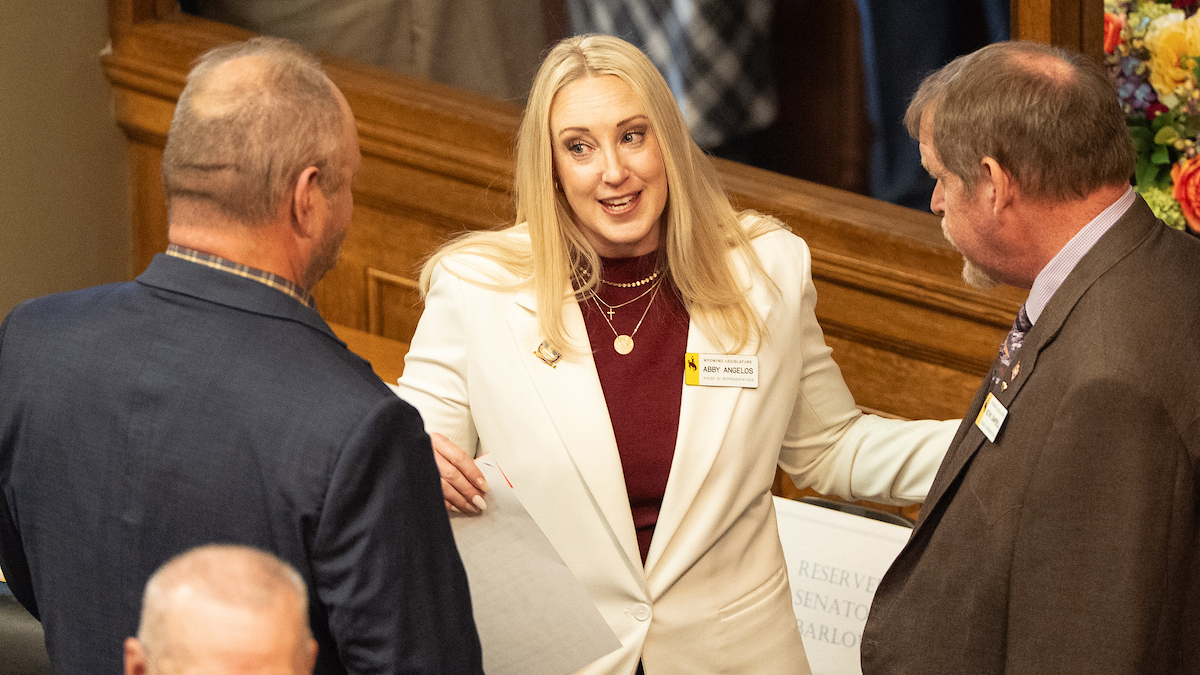
Rep. Abby Angelos, R-Gillette — photo by Michael Smith
GILLETTE — Campbell County legislative nominees met with Gillette College board of trustees to discuss some of the college’s biggest legislative challenges, including a state law that punishes local taxpayers.
State statute prevents college districts from accessing state money for certain things unless it assesses more mills. In simpler terms, people are getting taxed twice, board trustee Josh McGrath said, and they don’t see those tax dollars returned to their community from the Wyoming Legislature.
Wyoming state law requires community colleges to be accredited and levy four mills to receive state funding. Gillette College fulfills neither of those requirements yet, but it is working toward becoming accredited.
The college district only levies 3.6 mills because the board doesn’t need the full 4 mills. Trustees don’t want to raise taxes more than they have to, McGrath said.
Republican legislative nominees who attended the meeting included Rep. Abby Angelos, R-Gillette, Earl Collier, Doug Moore and Ronda Boller. Angelos is the Republican nominee for Senate District 23, while Collier, Moore and Boller won their respective House races in the primary.
“We run a very, very, very lean budget, and we want to be competitive with the south east (Wyoming community colleges), particularly with the nursing faculty,” said Trustee Teri Anderson. “It’s a struggle to get faculty because of where the wages are at, and so we want to give it back to the students and faculty to keep the college running, but right now it feels like we’re being held back while sending a lot of money to the state.”
Collier, the Republican nominee for House District 3, asked the board what kind of bill the college would need in order to prevent the double tax.
McGrath said that in light of accreditation, which the college estimates to be completed by February 2028, he wants more nuance in state law to allow the college to continue to assess less than four mills while receiving the state funding.
He said that if the college district chose to assess 0.4 more mills — which would bring in about $2 million, McGrath estimated — it could get as much as $14 million back from the state that it has been missing out on.
“The trustees struggle with, do you assess more and tax more to get $14 million back?” McGrath said. “We don’t tax more just because we want to, but we’re losing out on a lot of money that could come back to the district. I believe that Campbell County citizens and businesses are almost being double taxed. Once on the mineral severance tax that leaves here to fund everything in the state then taxed again on property tax to pay for it again.”
Angelos said she has tried to get her colleagues to support legislation that fixes this issue, but part of the struggle is getting lawmakers to understand how community colleges are funded.
Gillette College not being accredited also comes up frequently during budget negotiations as lawmakers balk at the prospect of an unaccredited college competing for state money with Wyoming’s accredited institutions.
McGrath said Gillette College’s old district, the Northern Wyoming Community College District, could also lose out on a massive amount of funding if Gillette gets a piece of the pie.
“Sheridan gets to count our enrollment from the state calculations, so when that money comes back to Northern Wyoming Community College District, it doesn’t come back to Gillette,” McGrath said. “They stand to benefit (from current laws) because their enrollment goes from, let’s say, 2,600 to 1,200.”
Sheridan’s battle now is to “create more runway” in its revenue as Gillette College approaches accreditation and will lose out on a lot of enrollment-based state funding to its district, McGrath explained.
Wyoming Association of Community College Trustee Executive Director Erin Taylor said all the confusion regarding community college funding has been a struggle to communicate with other districts.
College board members and Taylor talked about other laws that can “punish students” and taxpayers, such as a law that prevents students from touring Gillette College’s programs if they aren’t enrolled in Campbell County School District.
That law prevents students in Sundance, for example, from touring Gillette College’s Career and Technical Education programs, such as welding.
Taylor said that with some added help in the legislature, Campbell County taxpayers and students may get some relief.
But there are still a lot of persistent frustrations with the government bureaucracy dictating the college’s more granular operations, especially in light of what institutions garner most of the legislature's attention.
About 30,000 students are enrolled in Wyoming community colleges, Taylor estimated, or triple the University of Wyoming’s enrollment, which has been declining in recent years.
“Why is there a preference from the state?” Moore asked. “The exclusion doesn’t make sense to me.”
“Great question,” Angelos said.
Angelos argued that supporting community colleges is a strong way to convince young people not to leave Wyoming and support industry.
“I’ve always said the community colleges are where kids are trained to go into the workforce. They are extremely important. They keep kids home,” Angelos said. “They can graduate from college and get a good-paying job and stay here. That’s the whole goal, and I don’t know if that sentiment is felt everywhere.”
This story was published on Oct. 24, 2026.