


Experts say Thomas Jefferson medal real
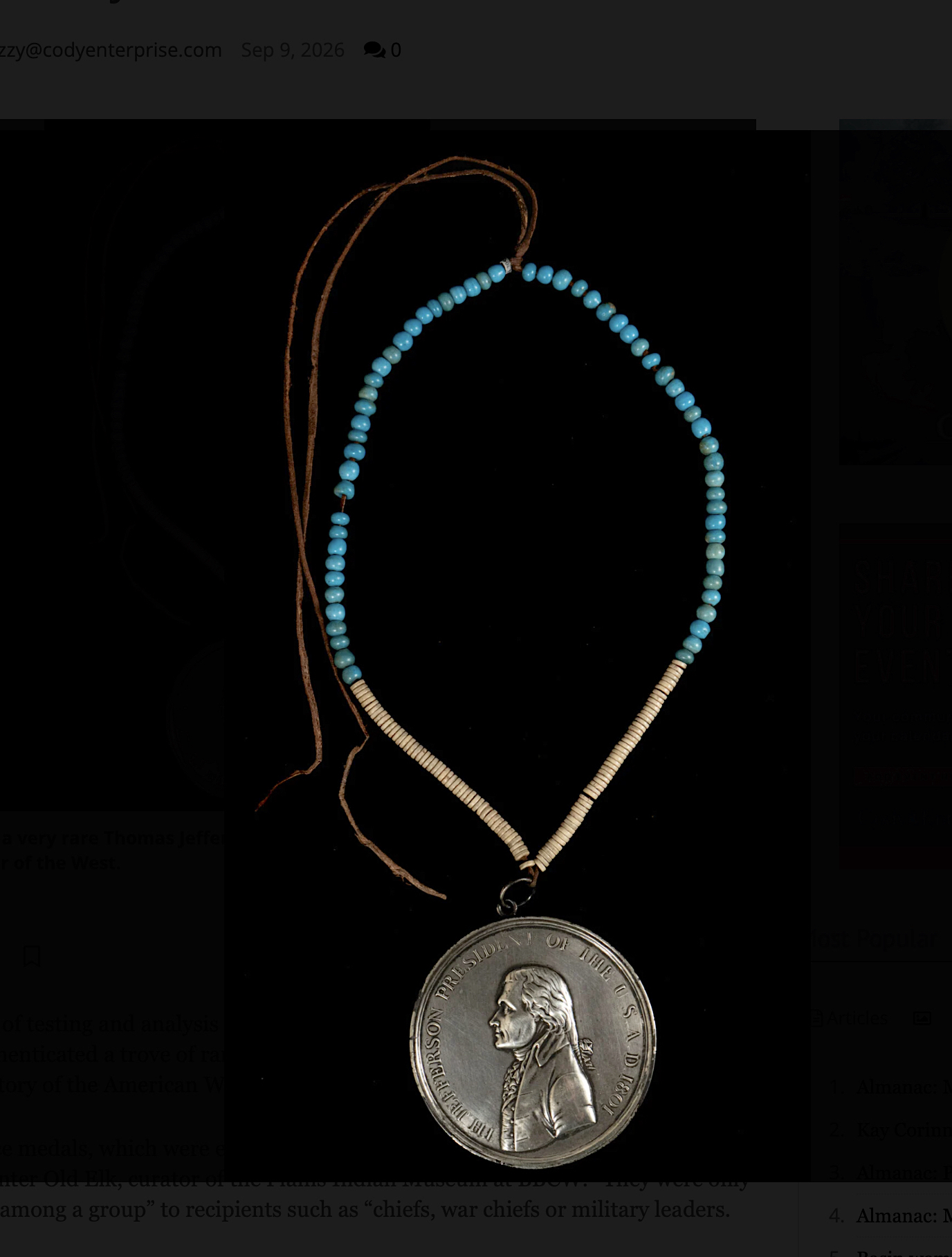
Experts recently authenticated a very rare Thomas Jefferson Peace Medal, carried by Lewis Clark and now on display at the Buffalo Bill Center of the West. Photo courtesy of the Buffalo Bill Center of the West.
CODY — Following a thorough course of testing and analysis carried out earlier this year, the Buffalo Bill Center of the West has definitively authenticated a trove of rare and historically significant medals tied to key periods and events in the history of the American West spanning more than 100 years.
Among them are Indian peace medals, which were esteemed as “elements of pride among Tribal communities,” explained Hunter Old Elk, curator of the Plains Indian Museum at BBCW. “They were only given to the highest, revered among a group” to recipients such as “chiefs, war chiefs or military leaders.
“They were worn probably daily, and became a daily use of adornment that was sometimes passed down through families.”
Some items in the collections have been hailed by experts as profoundly consequential, and are on view now at the center in the Rendezvous Hall.
Four are Indian peace medals presented to Tribal members during treaty negotiations and other interactions with U.S. representatives. One is exceptionally rare, with only three of its kind carried by Lewis and Clark on their 1804–1806 Corps of Discovery Expedition.
That medal is four inches in diameter, Old Elk said, a gift that was meant “to be friendly.” Usually Indian peace medals would be hung initially from a beautiful ribbon. On this one, a necklace was attached using blue padre beads and a white type of shell, strung on a red leather chord. Padre beads are “closely associated with the Spanish,” who brought them over from Spain when they colonized North America, and became trade material. Old Elk noted the quality of the necklace.
“Someone took a lot of pride in the material they used. Many medals were struck, mostly as commemoratives,” she said, but only those created during a short time period are considered Indian peace medals.
Those medals also served as “visual indicators for European trade interactions,” Old Elk added. “They assumed whoever was wearing it was a leader.”
Authentication process
“All of the medals have long resided in the Plains Indian Museum’s collections, and some had been previously displayed at the center. But exact details about the medals’ origins and authenticity were not fully known until this summer,” said Rebecca West, center CEO and executive director.
“We did not previously know the full extent of their significance in the cultural history of the American West, but we’re always working to learn more about our collections,” she continued. “Consequently, we have now gained substantially greater understanding of their exceptional nature.”
Among the medals evaluated and authenticated are the following:
• A large Thomas Jefferson Indian peace medal – known as a “shell medal” made by joining together two outer shells as front and back – which is one of only three such medals taken on the Corps of Discovery Expedition.
• A small Jefferson Indian peace medal, also a shell medal, which is one of only 16 of its kind taken on the expedition.
• Two other Indian peace medals, one awarded during the administration of Millard Fillmore (1850–1853) and one from the Franklin Pierce administration (1853–1857). Each is one of fewer than two dozen of its kind known to exist.
• Two fur trader medals, modeled after genuine Indian peace medals, that were given to Natives by fur-trading companies. Each is one of only eight known of its type to exist.
• Additional medals of various kinds dating to as early as 1804 and as late as 1913.
Preliminary analysis of relevant documentation indicates a high likelihood that both Jefferson Indian peace medals were presented to Native recipients during the Corps of Discovery Expedition, and the center is conducting ongoing research to determine additional details about these and other medals.
Among the 33 medals from the center’s Plains Indian Museum collection examined and tested this summer were other authentic medals similar to – but not the same as – Indian peace medals; genuine collector medals produced by the U.S. Mint; and so-called “fantasy” medals – forged peace medals struck by private individuals in an attempt to deceive recipients. Other medals were also determined to be counterfeits, including forged versions of George Washington oval peace medals, which have historically been highly subject to counterfeiting.
The rare and important genuine medals that were authenticated are “extremely important and add significantly to our history, and change the numismatic world,” said Dr. Lawrence J. Lee, an independent numismatic specialist hired by the center to evaluate the collection. From Lincoln, Neb., he has curated museum collections and consulted with multiple institutions regarding their numismatic holdings, and is among the world’s foremost specialists on Indian peace medals and related artifacts.
“Each of these genuine Indian peace medals has a unique and hugely significant historical backstory,” Lee said. “They have such important provenances that each can stand alone as a momentous artifact from our nation’s past.”
Based on historical documents, notes, and other authentication gathered and maintained with the medals, Lee said, “It might be possible to eventually trace two of the medals to their original recipients, which is quite rare.”
In addition to Lee’s physical inspection of the medals and supporting documentation, BBCW chief conservator Beverly Perkins conducted an X-ray fluorescence analysis of them.
“XRF is a widely used, non-destructive technique that determines the elemental composition of materials,” Perkins said. “It allows for a metallurgical comparison of the specific alloys used in the medals to known benchmarks, much the way historical paintings, tapestries or ceramics are often authenticated.”
Old Elk said, “The center has been and will continue to conduct extensive research on the history and specific provenance of these medals. As appropriate, we will consult with affiliated Tribes, as we do with all items in the Plains Indian Museum.”
John Pack, executive director of consignments for Stack’s Bowers Galleries, a leading U.S. numismatic auction house, said he was glad to see the center’s medals get their moment in the spotlight.
“Indian peace medals and the related medals of the fur trade are important historical objects that were part of the complex and fascinating interactions of European and Indigenous cultures across North America,” he said. “All too often, these objects lurk in the shadows of collections, and as a researcher in this field, I am delighted that the medals of the Plains Indian Museum are being celebrated and better publicized.”
This story was published on Sept. 9, 2026.
Ensure These Stories Are Told
Despite the challenges facing independent local journalism, what sustains us — and fills us with deep gratitude — is the loyal support of readers who believe our communities deserve accurate, trusted, and locally rooted news.
It is no exaggeration to say that we are here because of you. Every story we report, every local issue we follow, every public meeting we cover, and every community voice we lift up is made possible by readers who understand the value of an independent newspaper.
Your support does more than fund articles. It helps protect the independence that allows us to report honestly, ask important questions, and keep our community informed without fear or favor.
If you are able, please consider supporting the News Letter Journal by donating to our Unabridged Fund today. Whether your gift helps cover reporting time, printing costs, video, photography, editing, or distribution, every contribution helps keep local journalism strong in Wyoming.
All gifts are deeply appreciated. Your support helps ensure that local stories continue to be told, local decisions continue to be watched, and local voices continue to be heard.
Thank you for standing with independent community journalism.