


Color-coded stickers advise first responders of special needs
LANDER — For months after she began relying on a walker at home, Lander resident Deana Anderson found herself lying awake at night pondering how she would receive help in case of an emergency.
"I'd think, 'What if the house catches fire?'" Anderson recalled. "How would first responders know that I needed extra help to get out?"
In time, Anderson recognized that she likely wasn't alone in her fear. About one in seven people in the United States has a disability, and those who don't likely know someone who does.
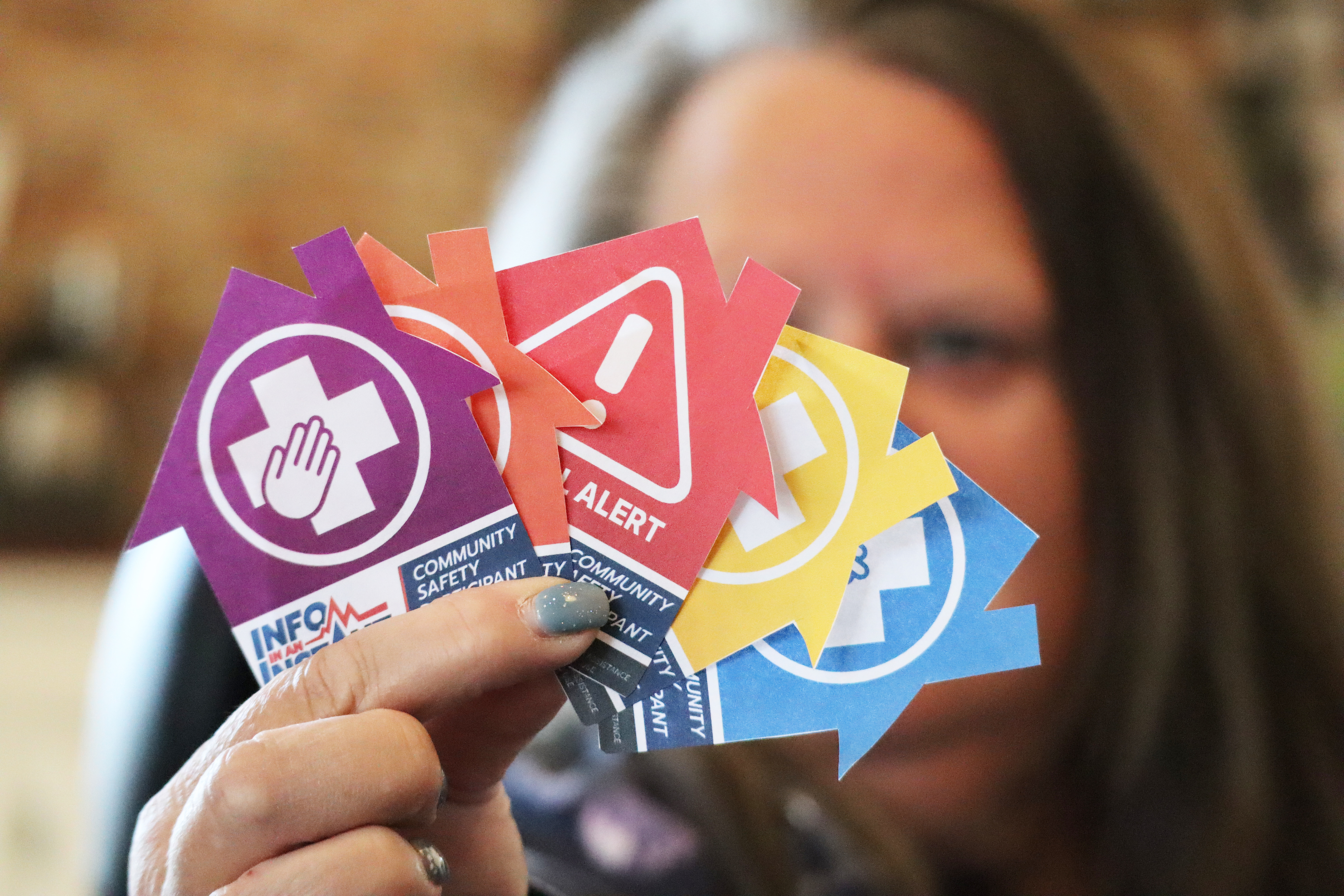
Motivated by that realization, Anderson channeled her concerns into "Info in an Instant," a new color-coded sticker system that will help police officers, firefighters and other first responders quickly recognize when a home or vehicle may contain someone with a disability or specific medical need.
The concept is simple, and, noted Anderson, long overdue.
Small stickers placed above door handles in the upper corner of entryways – or on the rear driver's-side window of a vehicle – subtly flag first responders that an occupant may have mobility limitations, sensory impairments, intermittent medical needs, or other disabilities.
Born with hip dysplasia, Anderson said she has spent much of her life adapting quietly to chronic pain, mobility limitations, and a world that often fails to consider the needs of people with disabilities.
In 2021, her mobility declined further and she began using a walker at home. The change forced her to consider the reality of worst-case scenarios and whether emergency responders would be able to provide assistance at the crucial moment.
"After months of worry, I suddenly understood, 'You can't change your personal system, but you could affect change on the greater system,'" she said.
Looking around her neighborhood, Anderson realized many of her neighbors may be in the same boat.
"The lady to the left of us uses a wheelchair," she said. "To the right of us, one of the people in that house uses a walker. Down the street is another lady that uses a walker. This isn't just a 'me' problem."
After researching disability statistics and speaking with local firefighters and police officers, Anderson landed on the idea of discreet stickers that could convey information instantly during chaotic emergencies.
"It's about peace of mind," she explained. "Like, I know the sticker is there, so they will know, too."
The system's design evolved with the help of first responder feedback and intentional care. Anderson said she intentionally avoided explicit labels, wheelchair symbols or large medical warnings that might publicly advertise vulnerability.
Instead, the stickers rely on abstract color coding and simple symbols recognizable primarily to trained first responders.
"That was one of the things she really thought through," said Fremont County Fire District Chief Ron Wempen. "The stickers are predominantly color coded, so not just anyone immediately knows what it means."
Wempen said older emergency-identification systems sometimes created unintended safety concerns. Decades ago, he recalled, fire departments commonly distributed "Tot Finder" stickers intended to identify children's bedrooms during fires, though many agencies later moved away from the practice over fears they could unintentionally identify vulnerable residents to bad actors.
"That's why they were done away with," Wempen said. "And that's why nothing like this really exists. But Deana has found a solution."
The Info in an Instant system includes categories for mobility limitations, cognitive disabilities, deafness and blindness, intermittent medical conditions, and hospice or bed-bound patients.
One category Anderson felt especially strongly about involved service animals.
In one scenario she imagined, firefighters responding to a house fire could mistake an unvested service dog for a pet interfering with rescue efforts.
"In cases like that, someone could be separated from their service animal during the confusion of an emergency," Anderson said. "We want to increase the odds of a good outcome."
During one meeting with local law enforcement, Anderson said she was asked whether the system could also work for vehicles.
"Oftentimes when people who are deaf get pulled over, it can be scary for all parties," she said. "The sticker could help avoid misunderstandings."
As Anderson rolls out the stickers later this month, vehicle decals will be included in the first batch.
Lander Police Chief Kelly Waugh expects that in certain situations, the stickers will help officers adapt under pressure.
"Oftentimes, when we're in a hurry to get through a door, we expect people to hear us, follow our commands, cooperate with what we're trying to do," Waugh said. "If we have knowledge before we even get in there that there is a different type of impairment, whether it's hearing or visual or anything like that, that helps us better suit how to deal with them."
Waugh called Info in an Instant "a huge benefit to all first responders."
Wempen agreed.
"Every second counts when trying to get people out of a burning structure," he said. "These stickers will direct our actions on that level."
Anderson received startup funding for the project through a grant from the LOR Foundation and worked with a graphic designer to develop the logo, branding and final sticker designs. Beginning with a distribution event from 10 a.m. to 2 p.m. on May 28 at the Lander Bake Shop – 259 Main Street – the stickers will be distributed free of charge.
She hopes to eventually distribute her initial print run of 11,000 stickers throughout Fremont County before expanding farther into Wyoming and beyond.
"Ideally, this will go nationwide," Anderson said. "Someday, maybe global."
For now, a second distribution event is in the works for Riverton. No matter how broad the stickers' reach eventually goes, Anderson said the effort will remain rooted in the same simple goal that sparked the idea: helping vulnerable people feel slightly safer not just during emergencies, but any time they're at home or in their car.
"If these stickers ease people's worry about their mom or their dad or their great Aunt Martha, then it's worth it," she said. "Let's make it happen."
This story was published on May 20, 2026.