


WOULD WE LISTEN TO NOAH?
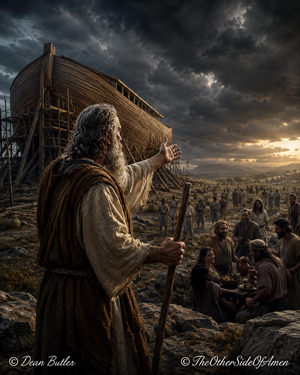
Would we listen if Noah warned us today? This message looks at sin, judgment, spiritual blindness, and why people reject the truth even when God speaks clearly.
Noah lived in a world filled with violence, corruption, and sin. Genesis says, “Every intent of the thoughts of his heart was only evil continually” (Genesis 6:5). The earth was not filled with ignorant people who could not think, build, plan, or work. It was filled with people who had become so blinded by sin that they refused to believe God.
God told Noah to build an ark, and the instructions were detailed. The ark was to be built to a certain size, with rooms, a roof, a door, and several levels. Noah had to gather materials, organize the work, and complete a project unlike anything anyone had seen before. He was not a foolish man. He had to be a skilled builder, a careful planner, and a man willing to obey God for many years.
Yet the people around him must have thought he had lost his mind.
Scripture calls Noah “a preacher of righteousness” (2 Peter 2:5). We are not told every word he preached, but his message would not have been hard to understand. Sin had brought God’s judgment. The world would be destroyed by water, and safety could be found only in the way God had provided.
That message sounded foolish because the people did not believe judgment was coming. They saw Noah building a massive ark while life continued as it always had. Jesus said that in the days before the flood, people were “eating and drinking, marrying and giving in marriage” until the flood came and took them all away (Matthew 24:38–39).
Eating, drinking, and marriage were not the problem. The problem was that people continued living as though God had said nothing. They were busy with ordinary life while ignoring the warning of coming judgment.
Noah’s preaching was ineffective because the problem was not lack of intelligence. It was love of sin.
The people did not reject Noah because they were unable to understand him. They rejected him because they did not want to believe a message that condemned the way they were living. The truth required them to admit they were wrong, turn from sin, and trust God about something they could not yet see.
Sin does more than lead a person to do wrong. Sin affects the mind, hardens the heart, and changes what a person is willing to believe. Jesus said, “The Light has come into the world, and people loved the darkness rather than the Light; for their deeds were evil” (John 3:19).
That same blindness is still at work today.
Suppose Noah were alive now and stood before the world warning that God’s judgment was coming. Would people listen, or would they laugh at him? Would they call him hateful, narrow-minded, judgmental, or out of touch? Would they tell him to stop talking about sin and speak about something more encouraging?
The harder question is whether the church would listen.
Some churches speak often about love, blessings, success, healing, and happiness, but very little about sin, repentance, holiness, or judgment. A modern Noah might not be welcomed in every pulpit. His message could be called too negative, too harsh, or too divisive.
Yet Noah was not preaching his own opinion. He was warning people about what God had said.
The ark itself became a sermon. Every board Noah placed was a warning. Every day the ark stood unfinished was another day of mercy. God gave people time, but time did not change their hearts. They continued in sin until the rain began to fall.
By then, the time for argument was over.
Hebrews says, “By faith Noah, being warned by God about things not yet seen, in reverence prepared an ark” (Hebrews 11:7). Noah believed God before he saw the first drop of rain. The world refused to believe until judgment was already upon them.
We often look back at Noah’s generation and wonder how people could have been so blind. Yet the same danger remains. God has warned that judgment is coming, Christ has called sinners to repent, and salvation is found only in Him.
The question is not whether Noah’s generation should have listened.
The question is, would we?
________________________________________________________________________
“What I write is not for everyone, but what I write is meant for someone.” – Dean Butler
This work may be shared for ministry or personal use, but please credit the author when doing so. © Dean Butler | The Other Side of Amen | All rights reserved.
