


The ‘Wall That Heals’ welcomes veterans home
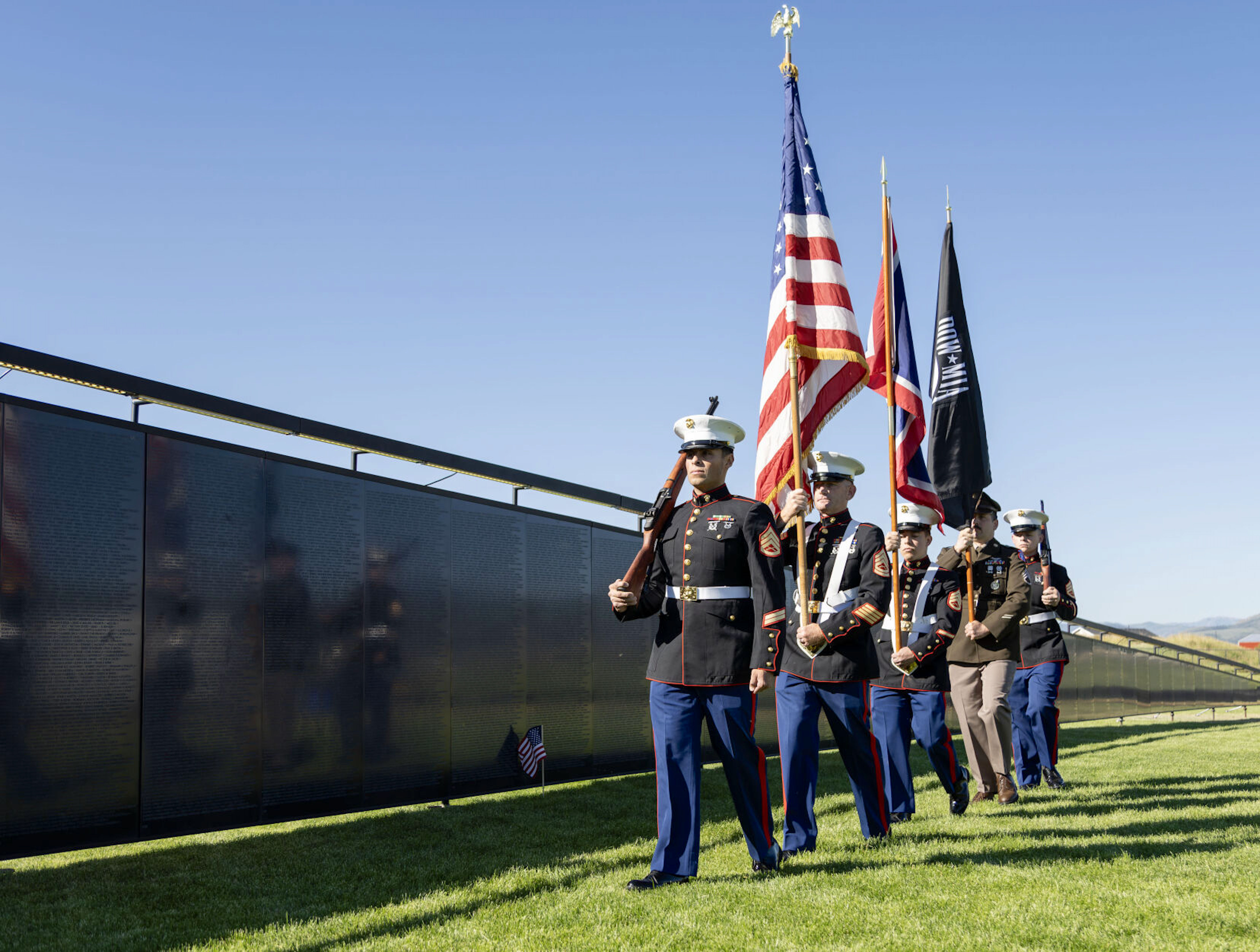
Veterans and families from Jackson to Lincoln County gather to see the traveling Vietnam veterans memorial.
JACKSON — As the sun reflected on 58,281 names on a traveling wall, veterans and family members gathered to remember those who served in Vietnam and did not return. For many, it was also a way to finally honor and welcome home Vietnam veterans.
A plane piloted by Vietnam veteran Phil Phillips circled above a field near Star Valley Middle School. A military color guard lined up to present the flag at the opening ceremony last Thursday, July 9, for the “Wall That Heals” memorial, a three-fourths size replica of the Vietnam Veterans Memorial in Washington, D.C.
Throughout the first day, event organizers and volunteers helped veterans and families find names of loved ones on the wall. Paper was distributed to make etchings and rubbings of the names in the wall, an exercise Tim Sheppard, executive director of Wyoming Veterans Commission, believes has been impactful.
“It really truly is the wall that heals,” Sheppard said.
After opening speeches, veterans gathered in the field to reminisce. Several veterans from Jackson drove down to Afton to be part of the ceremony and see the wall in person, including David Hill, a Vietnam-era veteran and member of Jackson Hole American Legion Post 43. Hill, a graduate of the U.S. Military Academy at West Point, said 18 of his classmates’ names were on the wall.
“I like to remember them all, and it’s hard,” Hill said. “Some of them were my best friends.”
Hill chatted with James Hillman, another West Point graduate who served in the years after the Vietnam War. The two called over T.R. Pierce and Ed Liebzeit, also both Vietnam veterans and members of the Jackson Post 43.
“I think the three of us all have names on the wall who we knew very well,” Hill said.
Pierce showed them a piece of paper with rubbings of friend’s names he had “tracked down” on the wall. He pointed out a woman visiting the wall, who carried a picture of her relative.
“I think about the families of the people [on this wall,] and the lives they had to live after that person didn’t come back from Vietnam,” Pierce said.
Liebzeit, who completed two tours in Vietnam, remembered the stress families and friends faced due to difficult and delayed communication by letter. He told his fellow veterans the story of his best friend who had been serving in Vietnam.
“I still remember to this day my best friend, the last letter I sent to him, I hadn’t heard back, and I was wondering why. I soon thereafter got this letter back with a big stamp on it that said ‘missing in action.’ I’ll never forget that day.”
As the four veterans stood in a circle remembering loved ones, they reflected on life after they returned from war. Liebzeit, in a previous interview with the News&Guide, said that the first thing he did when he got back from Vietnam was take off his uniform.
“I never went out in public in the uniform because people would give you negative comments, they’d spit on you,” Liebzeit said. “Not only did members of the military have post-traumatic stress disorder from the conflict itself, but they had it from re-entry.”
Liebzeit said that these types of events are “wonderful,” and that he appreciates the opportunity to gather with other veterans and to remember. Having this healing opportunity has been very positive, he said.
“When Gene said, ‘Welcome home,’ that’s more meaningful than you can probably imagine,” Liebzeit said. “I first heard ‘Welcome home’ 40 years after I returned.”
Hill, who served in Germany while his peers were in Vietnam, said life after the Vietnam war was difficult. There were many protests and soldiers were often shunned.
“It’s always nice, when we do parades, to hear people say, ‘Thank you for your service.’ It’s hard to believe, but for me it always makes an impression,” Hill said.
Hill said that he believes the “nation came around eventually,” and that Wyoming especially, is very patriotic and has a “wonderful feeling” toward veterans.
After his opening speech, Gov. Mark Gordon met and spoke with veterans and families attending the event.
“I think it’s impactful because it means that the country is actually bringing a little something more than rocks to the communities to thank people for their service,” Gordon said. “Wyoming … really remembers and understands the sacrifices that have been given.”
Gordon also highlighted ongoing work to include the names of soldiers who were mortally injured in Vietnam but died in neighboring countries.
The Vietnam Veterans Memorial Fund receives many requests to add names to the Vietnam Memorial Wall, according to the Vietnam Veterans Memorial Fund. Names that are eligible, approved by the Department of Defense, are added once a year.
Afton resident Ron Anderson located and made rubbings of names of family and friends who were killed in Vietnam. Anderson is part of a group that works to round up names of veterans who returned from Vietnam and have since passed away. The names are then added to a database, an extension of the wall. He said they’ve located almost 50 in western Wyoming, most of whom are from Star Valley.
“It’s ongoing recognition of veterans that served,” Anderson said. “They gave a lot.”
Many of the veterans Anderson has located have died due to complications from Agent Orange exposure or PTSD.
LaVor Jenkins, like many other veterans, searched for a friend’s name on the wall, the first time he has ever been able to do so in person. Jenkins said that after he came home from Vietnam, people spit on him and call him names.
Jenkins said that he and fellow soldiers were young – only 17, 18 or 19. The youngest American killed in Vietnam was 14, he added. For Jenkins and most of his fellow soldiers in Vietnam, the last history lesson they got was in high school.
“In that lesson they taught us that America hates to go to war,” Jenkins said.
Jenkins said they were taught that when Americans did go to war, they would go in and start building roads and hospitals, and leave.
“[We thought] we’re there to help, not to take over the place. That’s what we thought we were doing,” he said.
Jenkins, a Vietnam veteran from Freedom, said he was unable to see the Vietnam Memorial Wall in D.C. or The Wall that Heals when it came to Rock Springs. While he searches The Wall website for friends’ names occasionally, he said having the wall come to Afton is “pretty awesome.” He hopes that for many, the wall will be a time for healing.
“I’ve got a 57-year scab, so I’ve been healing for a long time,” Jenkins said. “But it’s nice to have people recognize we were soldiers too.”
Many veterans like Jenkins have been unable to see the Vietnam Wall in D.C. The traveling wall has helped bring healing to veterans in their own communities.
“We realize that there was a section of our population that, for one reason or another, couldn’t come to D.C., so we wanted to provide an opportunity to bring a national memorial out to all cities, large and small,” said Bryce Benson, who works with the Vietnam Veterans Memorial Fund.
Benson said that a large part of the Wall is the mobile education center that raises awareness about involvement in Vietnam. In addition, it helps people remember and pay respect to those who served.
“But also we recognize that our veterans, our service members that served in Vietnam, did not get the homecoming that they deserved,” Benson said. “So a big part of our mission here is to honor and preserve the legacy of the Vietnam veterans, and also to say, ‘Welcome home.’”
This story was published on July 16, 2026.
Ensure These Stories Are Told
Despite the challenges facing independent local journalism, what sustains us — and fills us with deep gratitude — is the loyal support of readers who believe our communities deserve accurate, trusted, and locally rooted news.
It is no exaggeration to say that we are here because of you. Every story we report, every local issue we follow, every public meeting we cover, and every community voice we lift up is made possible by readers who understand the value of an independent newspaper.
Your support does more than fund articles. It helps protect the independence that allows us to report honestly, ask important questions, and keep our community informed without fear or favor.
If you are able, please consider supporting the News Letter Journal by donating to our Unabridged Fund today. Whether your gift helps cover reporting time, printing costs, video, photography, editing, or distribution, every contribution helps keep local journalism strong in Wyoming.
All gifts are deeply appreciated. Your support helps ensure that local stories continue to be told, local decisions continue to be watched, and local voices continue to be heard.
Thank you for standing with independent community journalism.