


Lawmakers discuss technology in schools and activity funding shortage
CHEYENNE — Students and teachers met with state lawmakers Thursday to share a wide variety of concerns and potential solutions regarding funding for Wyoming’s public schools.
This included hearing about the harms and benefits of growing technology in the classroom, as well as how to address millions of dollars lost for school activities.
The meeting follows a shift in Wyoming education policy.
Earlier this year, the Legislature passed Senate File 81, a recalibration bill that implemented an “instructional silo.” This new model restricts hundreds of millions of dollars solely to classroom instruction and teacher raises, stripping local school boards of the flexibility they once had to move funds between different pools of money, like transportation, utilities and sports.
This legislative move was partly a response to a Laramie County District Court ruling that found the state had unconstitutionally underfunded schools. However, the practicalities of this new spending model dominated the day’s discussions.
Technology
The morning session of the Select Committee on School Finance Recalibration focused on technology funding; consultants and lawmakers debated the necessity of a one-to-one computer-to-student ratio.
Larry Pikus, a school finance consultant supporting the committee through the recalibration process, opened the discussion by arguing that while the delivery method, be it paper or screen, is a choice, “what matters is the quality of the instruction, not the way it’s delivered.”
The committee reviewed written testimony from Jared Cooney Horvath, a neuroscientist who argues that excessive screen time in early grades stalls cognitive development.
“The relationship is monotonic: more screen time, lower performance,” Horvath’s testimony stated.
Lawmakers expressed deep skepticism about the current push for one-to-one computing in elementary grades while also acknowledging the inevitability and importance of integrating technology into education.
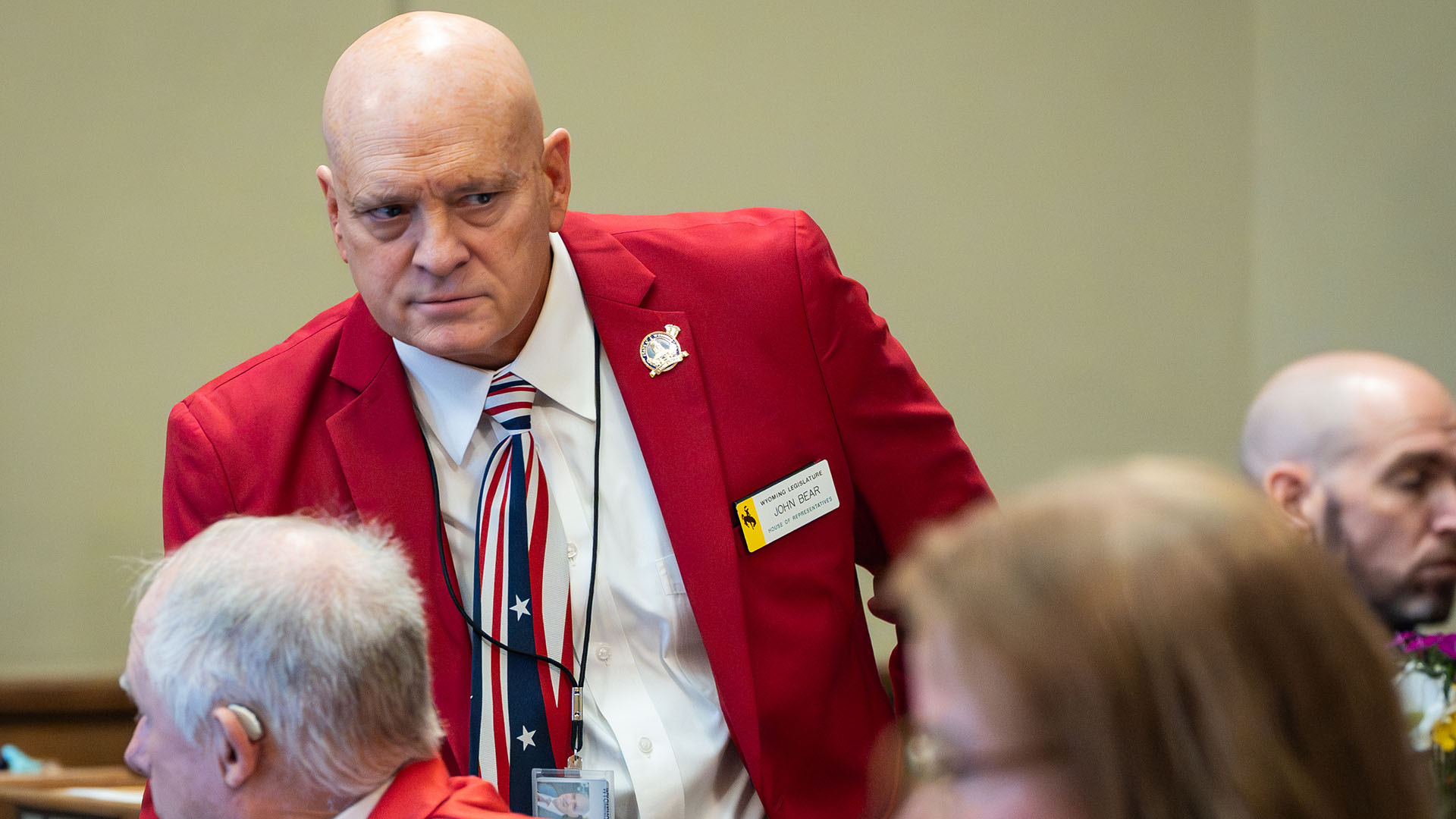
“We have a limited time with these students ... if we choose to prefer screen time, and in-person time has a higher effect, better effect, then we have chosen ... a negative outcome,” said Rep. John Bear, R-Gillette.
Kylie Wall, a student who graduated high school just 26 days prior, gave an account of how she believes technology failed her. Wall testified that teachers and students became overreliant on artificial intelligence tools like ChatGPT and Grammarly, which she described as “addicting” and “instant gratification” that “scrambled” her brain.
“I personally feel like the public school system has failed me because of technology,” she said, recommending a return to computer labs, rather than personal laptops. “... We’re losing our capabilities, and we’re becoming so reliant on technology. I know so many students who aren’t even capable of being able to formulate a proper sentence or when to use a comma or when to use a semicolon.”
Another former student and recent graduate, Avery Schultz, shared her experience with a district-sanctioned online library, Sora, which she testified allowed her access to “sexually explicit books” before she was developmentally ready.
School administrators, however, cautioned that cutting technology funding would ignore the massive infrastructure required to run a modern district.
Charlie Kaufman, chief operations officer for Washakie County School District 1, noted that his district recently spent $220,000 on network switches and $50,000 on fiber loops — costs not reflected in the per-student device model.
Matt Ayers, a tech director for Fremont County School District 38, noted that he spends $121,000 annually just on software subscriptions like PowerSchool and ransomware protection, which “doesn’t even touch” student-facing apps.
While attendees spurred discussions regarding both technology in classrooms and behind the scenes, administrators generally sought broader solutions, arguing the current model ignores expensive district infrastructure like servers, fiber loops and cybersecurity. Administrators requested a working group to evaluate if the funding model’s staffing assumptions and infrastructure support, not just student devices, remain aligned with modern district operational needs.
However, Sen. Bo Biteman, R-Ranchester, stated that the scope of the debate is limited to computer-to-child ratios because that is how he interpreted Judge Peter Froelicher’s ruling that found the state unconstitutionally underfunded its public schools.
School activities
The afternoon discussion shifted to student activities, where the committee faced an outcry over a $3.8 million statewide decrease in activity funding caused by a formula change in SF 81. Previously, activity funding was school-based, providing extra support for small schools; the new formula is district-based, which penalizes small schools that happen to be attached to larger districts.
Matthew Wilmarth, Legislative Service Office budget administrator, explained that 22 districts are expected to lose funding under the new approach.
This is most severe for districts like Lincoln County School District 2, where Cokeville High School, a small school 50 miles away from the district hub, saw its activity funding drop from $2,500 per student to just $830.
Kenneth Dietz, the principal of Cokeville schools, testified via Zoom just before a scheduled power outage in his town. He explained that his district had previously used “creative accounting” and fewer personnel to protect successful programs like cheer and wrestling, but the new instructional silo made that impossible.
“This legislation created a $130,000 hole in Cokeville activities that would have killed all activities in Cokeville within a single year,” Dietz said, saying even previous funding was inadequate.
Shannon Davis, a parent who drove three-and-a-half hours from Cokeville to Lander, where the meeting was held, described the local high school as the “heart of our town.”
“It would be devastating to our entire economy to require us to fundraise an extra $200,000 each year to keep our activities afloat,” she said, adding that without these programs, she would likely choose to homeschool.
The “greater of” compromise
Recognizing the severity of the situation, the committee began brainstorming a fix. Committee members discussed a proposal to let districts receive the “greater of” the two funding formulas.
During a brief recess, Wilmarth calculated that this “greater of” approach would require a $5.3 million statewide increase. Under this plan, 25 districts would use the new formula, and 23 would stick with the old one, ensuring that no district loses money.
Lawmakers were largely supportive, though Biteman cautioned that the committee must remain “cost-based” and not just go on “what feels good.”
Sen. Chris Rothfuss, D-Laramie, agreed that this solution seems to be the most “eloquent solution or the path of least resistance” to restore funding in an equitable manner.
However, Travis Pearson, chairman of the Johnson County School District 1 board, warned that the “greater of” formula for activities was only a small part of the problem. He told the committee that by siloing teacher raises, the state had inadvertently revealed that many districts were using “ghost teachers,” funding for positions they couldn’t fill, to pay for basic operations like utilities and insurance.
“We’re 50% short on operations when you created the silo,” Pearson said. “Now we’ve got to actually fund what it costs to run a school district.”
Next steps
As the meeting wrapped up, Co-Chairman Rep. Scott Heiner, R-Green River, expressed optimism that the committee had narrowed its focus.
“I’m particularly excited about what we’ve come up with for activities,” he said.
He reassured the public that the committee views activities as “an extension of the classroom” and intended to refine the “greater of” proposal into a bill draft for the next legislative session.
LSO staff were directed to return in August with precise figures for the activities recommendation and to further explore the technology simulation model. The committee will also delve deeper into the needs for school resource officers and nutrition programs that were discussed earlier this week at future meetings.
This story was published on June 26, 2026.
Ensure These Stories Are Told
Despite the challenges facing independent local journalism, what sustains us — and fills us with deep gratitude — is the loyal support of readers who believe our communities deserve accurate, trusted, and locally rooted news.
It is no exaggeration to say that we are here because of you. Every story we report, every local issue we follow, every public meeting we cover, and every community voice we lift up is made possible by readers who understand the value of an independent newspaper.
Your support does more than fund articles. It helps protect the independence that allows us to report honestly, ask important questions, and keep our community informed without fear or favor.
If you are able, please consider supporting the News Letter Journal by donating to our Unabridged Fund today. Whether your gift helps cover reporting time, printing costs, video, photography, editing, or distribution, every contribution helps keep local journalism strong in Wyoming.
All gifts are deeply appreciated. Your support helps ensure that local stories continue to be told, local decisions continue to be watched, and local voices continue to be heard.
Thank you for standing with independent community journalism.