


Fire threat continues — Recent rain hasn’t erased wildfire danger, fire warden warns
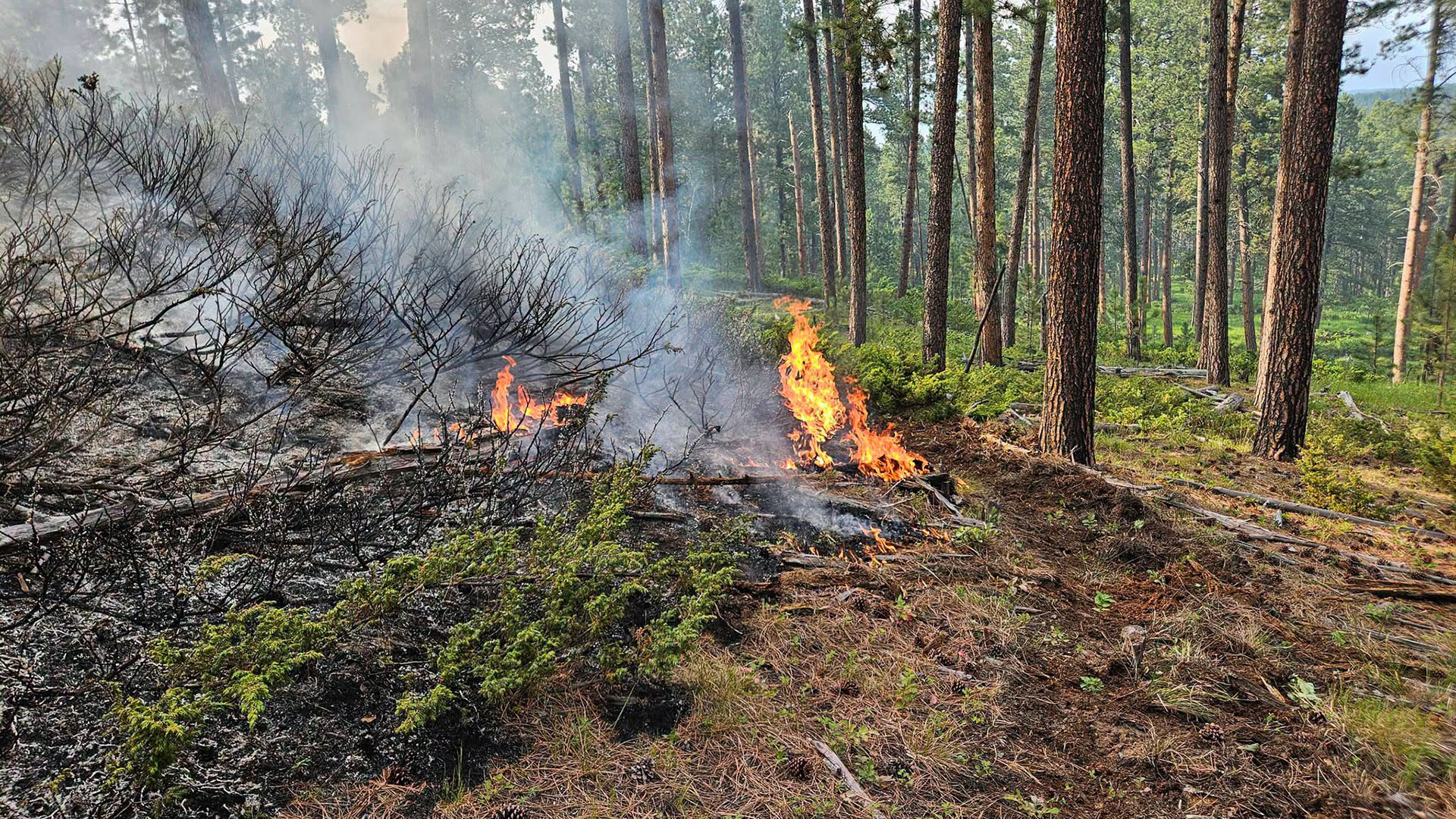
A photo from the Cold Springs Fire on June 27 in the Black Hills — photo courtesy Daniel Tysdal and the Weston County Fire Protection District
Despite scattered rain showers across Weston County in recent days, wildfire danger remains very high, and officials say the public should not mistake temporary moisture for lasting relief.
The warning comes as Weston County was under another National Weather Service Red Flag Warning on June 29, with hot, dry and windy conditions expected to elevate wildfire danger once again. Because of the continuing fire risk, fireworks remain prohibited throughout Weston County and within the city of Newcastle ahead of the Fourth of July holiday.
According to Weston County Fire Warden Daniel Tysdal, brief precipitation does little to reduce the long-term wildfire threat because different types of vegetation absorb and lose moisture at dramatically different rates.
“Moisture content is the single most important factor in determining how well a fuel will ignite and burn,” Tysdal said in information released to the public explaining why the county remains in very high fire danger.
Tysdal explained that wildfire fuels fall into two categories: live fuels, such as grasses, shrubs and trees, and dead fuels, including leaves, pine needles, branches and logs.
Live fuel moisture depends on factors such as plant species, seasonal growth and drought conditions. Dead fuels, however, respond much more quickly to weather conditions, with humidity, rainfall, sunlight and wind determining how much moisture they contain.
Dead fuels are also classified by size, which determines how quickly they dry after rainfall.
Fine fuels — grasses, pine needles and dead leaves less than one-quarter inch in diameter — are known as one-hour fuels because they can return to dry, combustible conditions within about an hour after weather conditions improve.
“They absorb water rapidly during a storm but act exactly like a dry sponge,” Tysdal said. “The moment the sun comes out and the humidity drops, these fine fuels immediately release that moisture into the air.”
Larger fuels require far more time to absorb meaningful amounts of water.
Branches measuring one-quarter inch to 1 inch in diameter, called 10-hour fuels, may become damp on the surface during a rainstorm, but their cores often remain dry. Limbs measuring 1 to 3 inches across, known as 100-hour fuels, require several days of soaking rain before their internal moisture increases significantly.
The largest fuels — logs and heavy timber more than 3 inches in diameter — are classified as 1,000-hour fuels because they require weeks or even months of sustained wet conditions to substantially reduce their fire potential.
“A quick rain or two does absolutely nothing to alter their internal moisture,” Tysdal said of the largest fuels. “These heavy fuels will catch fire, burning deeply and intensely, long after any rain clouds have passed.”
The county’s prolonged drought further compounds the problem by reducing moisture in living vegetation while leaving heavy dead fuels extremely dry.
Because weather conditions in northeast Wyoming often shift rapidly from scattered showers to low humidity, sunshine and wind, Tysdal said any benefit from rainfall is short-lived.
“When a rain shower or even a few days of showers move across the region and drop some quick precipitation, we may get an immediate sense of relief,” he said. “However, brief rain showers do very little to permanently alter the underlying wildfire danger.”
Recent fire activity across Weston County has reinforced that message.
Several grass and timber fires reported during the past week were knocked down by rainfall before firefighters arrived. Even so, each incident prompted significant responses from Weston County firefighters and cooperating agencies because fuels remained capable of supporting rapid fire growth.
A timber fire on June 27 near Lost Canyon in the Black Hills National Forest grew to 3.5 acres despite an aggressive initial attack that included helicopters, air tanker drops, hand crews, heavy equipment and numerous engines.
According to Tysdal, that fire illustrates the dangerous conditions that continue to exist throughout the region.
With the Fourth of July approaching, local fire officials continue to urge residents to respect the fireworks prohibition and remain vigilant to prevent human-caused fires during the ongoing period of elevated wildfire danger.
Recent wildfire activity in Weston County
Despite scattered rainfall, firefighters have responded to multiple wildfire incidents across Weston County in the past week.
June 22
Cave Springs incidents: Firefighters responded to reports of smoke north of Newcastle and discovered two illegal debris burns. Crews extinguished both fires. Response included seven engines, one dozer, two tenders and three command units.
Windmill fire: A grass fire north of the YT Ranch was largely knocked down by rain before firefighters arrived. Responders included five engines, one tender, one blade, one dozer and three command units.
June 26
Old Horse fire: A grass fire southwest of the Soda Butte-Raven Creek Road intersection was quickly contained after light rain reduced fire activity. Resources included 10 engines, two tenders, one dozer, one blade, one wet squad and one command unit.
June 27
Cold Springs fire: Weston County assisted on a timber fire in the Black Hills National Forest near Lost Canyon. Despite an aggressive response involving helicopters, air tanker drops, hand crews, heavy equipment and multiple engines, the fire reached 3.5 acres before containment efforts succeeded. Weston County sent two engines, one tender, one dozer and one command unit.
June 28
Soldier fire: Firefighters responded to a timber fire northeast of Four Corners near Purvis Road. The blaze was contained at 0.21 acres. Resources included seven engines, three tenders, one dozer, one skid steer, one squad, one command unit and a helitack crew.
Ensure These Stories Are Told
Despite the challenges facing independent local journalism, what sustains us — and fills us with deep gratitude — is the loyal support of readers who believe our communities deserve accurate, trusted, and locally rooted news.
It is no exaggeration to say that we are here because of you. Every story we report, every local issue we follow, every public meeting we cover, and every community voice we lift up is made possible by readers who understand the value of an independent newspaper.
Your support does more than fund articles. It helps protect the independence that allows us to report honestly, ask important questions, and keep our community informed without fear or favor.
If you are able, please consider supporting the News Letter Journal by donating to our Unabridged Fund today. Whether your gift helps cover reporting time, printing costs, video, photography, editing, or distribution, every contribution helps keep local journalism strong in Wyoming.
All gifts are deeply appreciated. Your support helps ensure that local stories continue to be told, local decisions continue to be watched, and local voices continue to be heard.
Thank you for standing with independent community journalism.